
From the very beginning of our web development journey, we’re taught that mastering Clean Code is the ultimate aspiration. It sounds perfect, doesn’t it?
However, when building enterprise-scale applications, clean code alone is insufficient—and I’d even argue that a neat folder structure isn’t enough either.
For sustainable, long-term maintainability, we require a Scalable Architecture that stays performant as both code complexity and team size expand.
This article zeroes in on what’s called a Modulith—a Modular Monolith: a singular deployable frontend whose internal design mimics micro-services.
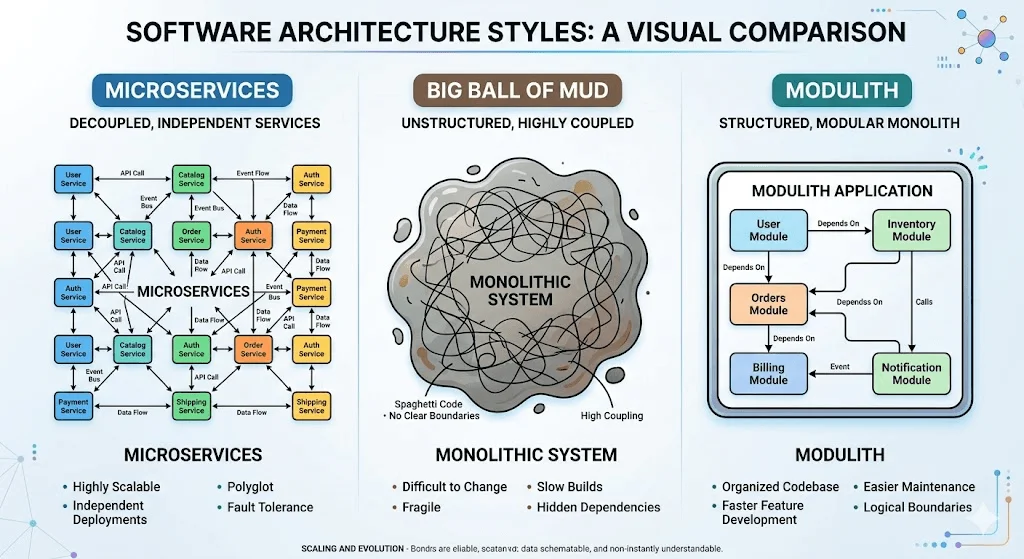
Many developers equate a tidy folder layout with a clean architecture. While organization is undeniably important, it’s not sufficient by itself.
Examine this typical Angular project structure:
src/app/
├── core/
│   ├── guards/
│   ├── interceptors/
│   └── services/
├── shared/
│   ├── pipes/
│   ├── utils/
│   └── components/
└── features/
    ├── products/
    │   ├── state/
    │   ├── components/
    │   ├── services/
    │   ├── models/
    │   └── products.component.ts
    └── users/
At first glance, this separation looks great, and conceptually it is—each folder has a defined role:
- Core: Application-wide singleton logic—auth guards, HTTP interceptors, startup services.
- Shared: Reusable UI components, pipes, directives, and utility functions.
- Features: Business logic grouped by domain (Products, Users, etc.).
But here’s the catch: this layout provides no guarantee about dependency direction.

Circular Dependencies
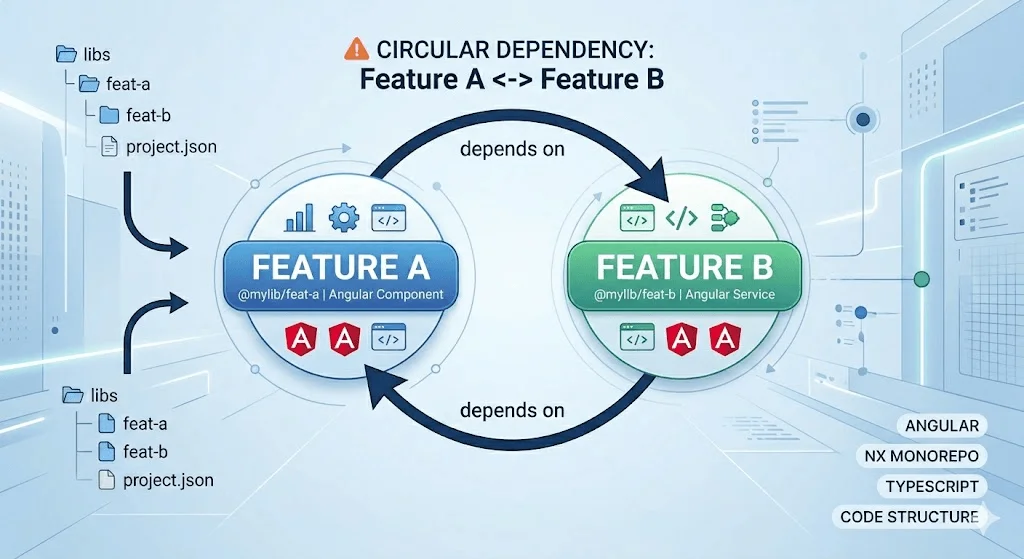
Imagine you have a service in the Products feature that inadvertently imports something from Users. Weeks later, a developer on Users introduces an import back into Products. That’s a Circular Dependency—a closed loop where Feature A depends on Feature B, which depends right back on Feature A.
This isn’t merely a code smell; it’s a structural failure. Tightly coupled features can’t be changed or tested independently. Any modification in one risks breaking the other, and eventually, complexity spirals out of control, making maintenance a nightmare.
Clean Code’s Limits
Clean code tends to be highly localized. You might craft an elegantly written function or a perfectly structured component that looks pristine in isolation, but without proper architecture, it neither contributes to system coherence nor prevents chaos.
In large-scale apps, the question shifts from “how do I write a good function?” to “where does this function belong?” Without enforced architectural boundaries, even well-intentioned developers can unintentionally create systemic failures. When that occurs, large-scale refactoring becomes a terrifying prospect.
The Code Review Dilemma
Let’s face it—we’ve all been there. Deadlines loom, time is short, and a code reviewer might be tempted to loosen standards to ship on schedule.
Reviewers typically focus on visible aspects—clean code, apparent bugs, a quick scan for memory leaks. But what about critical architectural flaws? Think circular dependencies or inverted dependency workflows.
These deep structural issues often slip through because we, as human developers, aren’t wired to track system-wide dependencies across a massive monorepo. This realization brings us to a key principle:
“If a rule can be automated, it must be automated.”
Manually catching issues that could be automated is a massive drain on both developer time and reviewer mental bandwidth. Automation handles these instantly and consistently. By saving that effort, reviewers can concentrate on what truly matters: business-critical decisions, potential bugs, memory leaks, and more.
Nx is more than just a tool for supercharging builds—at its core, it’s a robust mechanism for enforcing architecture. We’ve all had that experience: telling the team in a meeting “please don’t import a feature into a core service,” only to discover months later that it’s happened and requires refactoring.
Instead of expecting the team to remember rules, Nx actively enforces them and flags violations when they occur.
Tags and Lint Rules
The beauty lies in its simplicity. You assign tags to libraries—like `type:feature` or `type:ui`, `scope:products` or `scope:shared`—and then define strict boundary rules around those tags. You can literally set a rule such as:
“Libraries tagged ‘scope:products’ may import from ‘scope:shared’. Never the reverse.”
Here’s how it plays out in practice:
// project.json
{
  "name": "products-feature",
  "tags": ["scope:products", "type:feature"]
}
// .eslintrc.json
{
  "@nx/enforce-module-boundaries": ["error", {
    "depConstraints": [
      {
        "sourceTag": "scope:products",
        "onlyDependOnLibsWithTags": ["scope:products", "scope:shared"]
      }
    ]
  }]
}
If a developer attempts to cross that line, the linter immediately catches the violation. This rule not only frees up reviewer time but also enhances system robustness and consistency.

Blocking Inverted Dependency Flows
Clear communication between application layers is crucial in a clean architecture. Think about it: should a presentational component know about a heavy-duty smart component? Should a core service be aware of a feature encapsulating business rules? Absolutely not. By tagging feature libraries as `type:feature` and UI libraries as `type:ui`, we prevent accidental imports of features into UI libraries:
// type:ui can never import from type:feature
// The linter will catch it immediately — every time
This is enforced through pre-commit hooks in your IDE or as a final check in CI. The system guarantees that problematic code never reaches your main branch.
In an Angular Modulith, Nx shines when libraries follow a consistent structure organized by both scope and type. Each library has a clear, singular responsibility.
There are four standard library types—once you grasp them, you’ll wonder how you managed without this framework.
data-access
This is the home for all state management and API communication. NGXS state slices, selectors, HTTP service calls—they all reside here. The core principle: nothing outside the data-access layer should know how data is fetched or mutated.
// libs/products/data-access/src/lib/products.state.ts
export interface ProductsStateModel {
  products: Product[];
  loading: boolean;
}


@State<ProductsStateModel>({
  name: 'products',
  defaults: { products: [], loading: false }
})
@Injectable()
export class ProductsState {
  @Action(LoadProducts)
  loadProducts(ctx: StateContext<ProductsStateModel>) {
    ctx.patchState({ loading: true });
    return this.productsService.getAll().pipe(
      tap(products => ctx.patchState({ products, loading: false }))
    );
  }
}
ui
This contains only pure, presentational components. These components receive data via `input()` and communicate changes via `output()`. They have zero awareness of application state, routing, or business logic. Housing them in a UI library makes them effortless to reuse.
// libs/products/ui/src/lib/product-card.component.ts
@Component({
  selector: 'app-product-card',
  // ...
})
export class ProductCardComponent {
  product = input.required<Product>();
  addToCart = output<Product>();
}
feature
Feature-type libraries represent a vertical slice of your application. They own a business domain, orchestrate data and UI, inject data-access state slices, and manage user interactions and flows. They serve as entry points for routed pages.
// libs/products/feature/src/lib/product-list.component.ts
@Component({ selector: 'app-product-list', ... })
export class ProductListComponent {
  readonly state = inject(ProductsState);
}
utility
Any stateless pure function belongs here. It’s where you’ll find data formatters, validators, and custom RxJS operators. It’s your toolbox, ready for frequent reuse.
The outcome of a clean architecture built on these layers is a dependency graph that flows in one direction—never the reverse:
feature  →  data-access
feature  →  ui
feature  →  utility
ui       →  utility
With Nx boundaries automatically enforcing these rules, the graph can never be compromised—regardless of team size, project age, or deadline pressure.
But wait, here’s a common objection: “Setting up all this structure takes time. We need to ship fast!” And yes, it requires upfront effort. But good architecture isn’t a luxury—it’s a decision that compounds in value as the project matures.
Let me explain what I mean.
Nx Computation Caching
Nx caches the output of every task—builds, tests, linting—locally and, optionally, in a shared distributed cache. If your recent changes don’t touch a particular library, Nx retrieves the cached result in milliseconds instead of re-running the task.
nx run-many --target=test --all
# Only re-runs tests for affected libraries
# Everything else? Cache hit ✓  — instant.
On a large monorepo, this can cut CI time from 20 minutes to under 2. That’s a massive win!
Reduced Cognitive Overhead
Should this file go in shared or core? Is this UI or a feature? When every library has a clearly defined type and scope, developers immediately know where to place new code and where to look for existing code.
Moreover, when a newcomer joins the team, they don’t spend hours deciphering the structure. It’s self-documenting. The library name reveals its scope; the type reveals its responsibility. That’s a win for onboarding.
Multiple Teams, Zero Conflict
With library boundaries in place, multiple teams can work within the same monorepo without interfering with each other. Team A owns `scope:products`. Team B owns `scope:orders`. Their work is isolated by design.
To sum up the ROI: the real cost isn’t the time spent setting up the structure—it’s the time you continuously lose without it. Slower onboarding, longer CI pipelines, and reviews that overlook critical issues. That cost accumulates every single sprint.

Being a Senior Developer or Architect means seeing the whole system, not just the function in front of you.
We began this article discussing Clean Code—and don’t mistake me, it’s still valuable. But it’s a local concern. It won’t protect you from circular dependencies, inverted flows, or a codebase that becomes unnavigable after two years of growth.
The Modulith approach we’ve explored—Nx boundaries, library types, enforced dependency flows—is what enables an application to scale across five teams for the next three years.
Thank you for reading!!