

My debut on stage is still vivid in my memory. The anxiety was overwhelming, and my mind was racing with doubts. Would my subject resonate? Would the room be empty? What if my memory failed me completely? Having since presented at ng-India, DevDays Europe, FrontEnd Nation, and numerous other global events, I can confirm that these anxieties never truly vanish. You simply develop strategies to coexist with them and channel that adrenaline into a compelling performance.
Initial Steps Before Submitting a Proposal
The common assumption is that a presentation begins when you step into the spotlight. In practice, the heavy lifting happens much earlier, starting with the decision to even send in a proposal. For me, this phase presented the first significant challenge: the persistent belief that I had no unique insights to offer.
Despite years of Angular experience, solving complex architectural problems and managing teams, I was convinced my knowledge was common. It was only through conversations with peers that I discovered my standard solutions were not universally understood. What felt routine to me was often revolutionary for others.
Selecting a Subject - Identifying Your Core Message
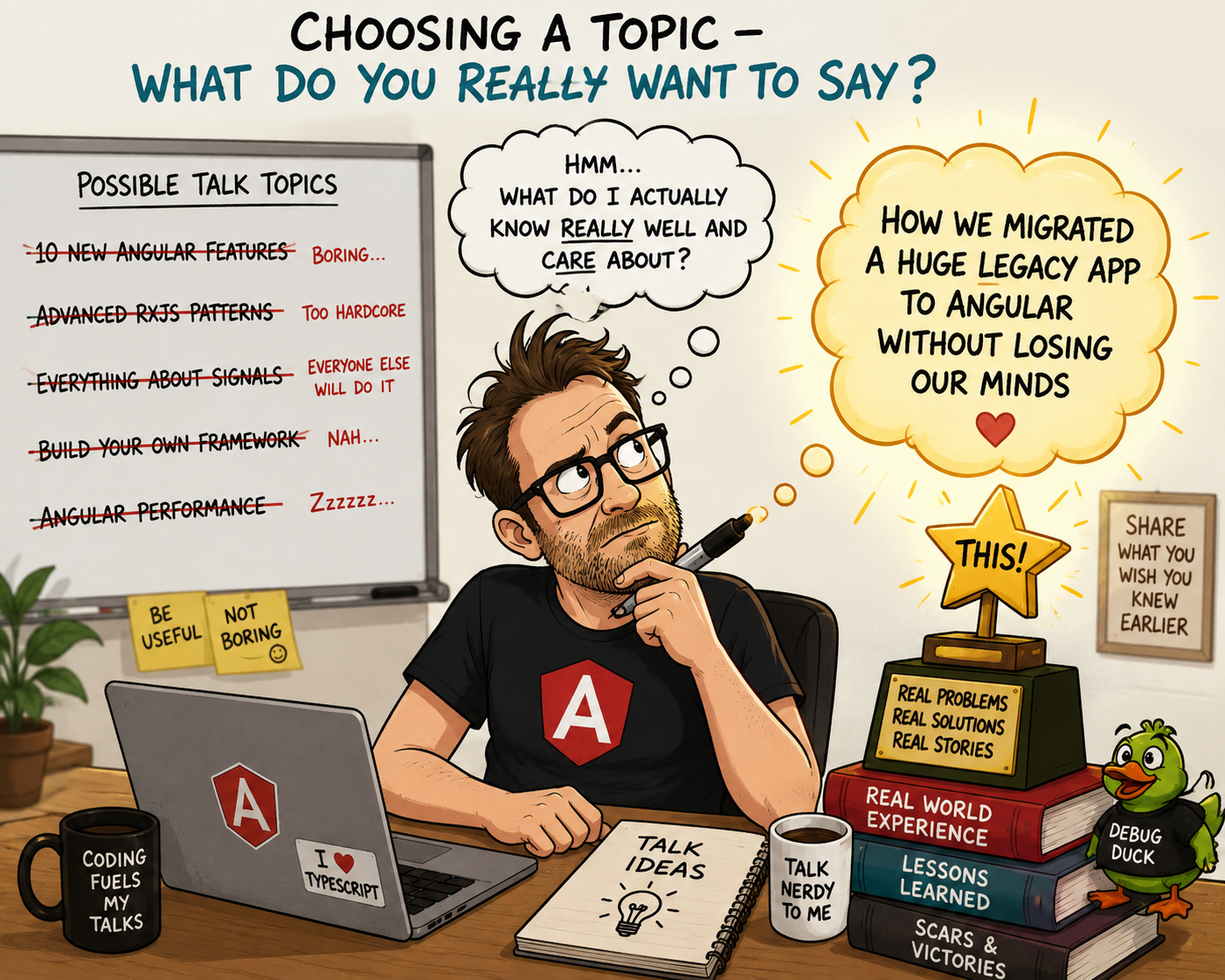
In my early days of conference preparation, I obsessed over finding the perfect subject. Countless ideas crossed my mind, but none seemed satisfactory. The breakthrough came when I understood that the most effective talks are grounded in genuine experience. You don't need a groundbreaking innovation; you need to articulate a lesson you've truly lived through.
The themes I've presented on were almost all born from real-world challenges encountered during my work. Their familiarity allowed me to discuss them with genuine expertise, covering nuances and solutions effortlessly. Here is my primary advice:
select topics that are authentic to you, rather than those that are merely fashionable. Authenticity is a speaker's most valuable asset.
The CFP Phase
Conferences typically open a Call for Papers, a submission window for speaker proposals. You'll be required to outline your talk, write an abstract, and often share a brief bio. With major international events receiving a flood of submissions, your proposal must distinguish itself from the crowd.
My experience has taught me that an effective abstract acts as a clear offer of value to potential attendees. It’s less about a formal description and more about what the audience gains. For example, rather than stating,
"I'll discuss Angular state management,"
frame it as,
"Learn to sidestep three critical state-management errors, which will save your team from weeks of unnecessary debugging."
This nuance, while subtle, is powerful. The latter formulation immediately conveys the tangible outcome for the listener. Additionally, program committees often seek balance. Talks on practical topics, such as modernizing a legacy codebase, can be more appealing than another session on the newest shiny feature.
Crafting the Deck - Prioritizing Simplicity
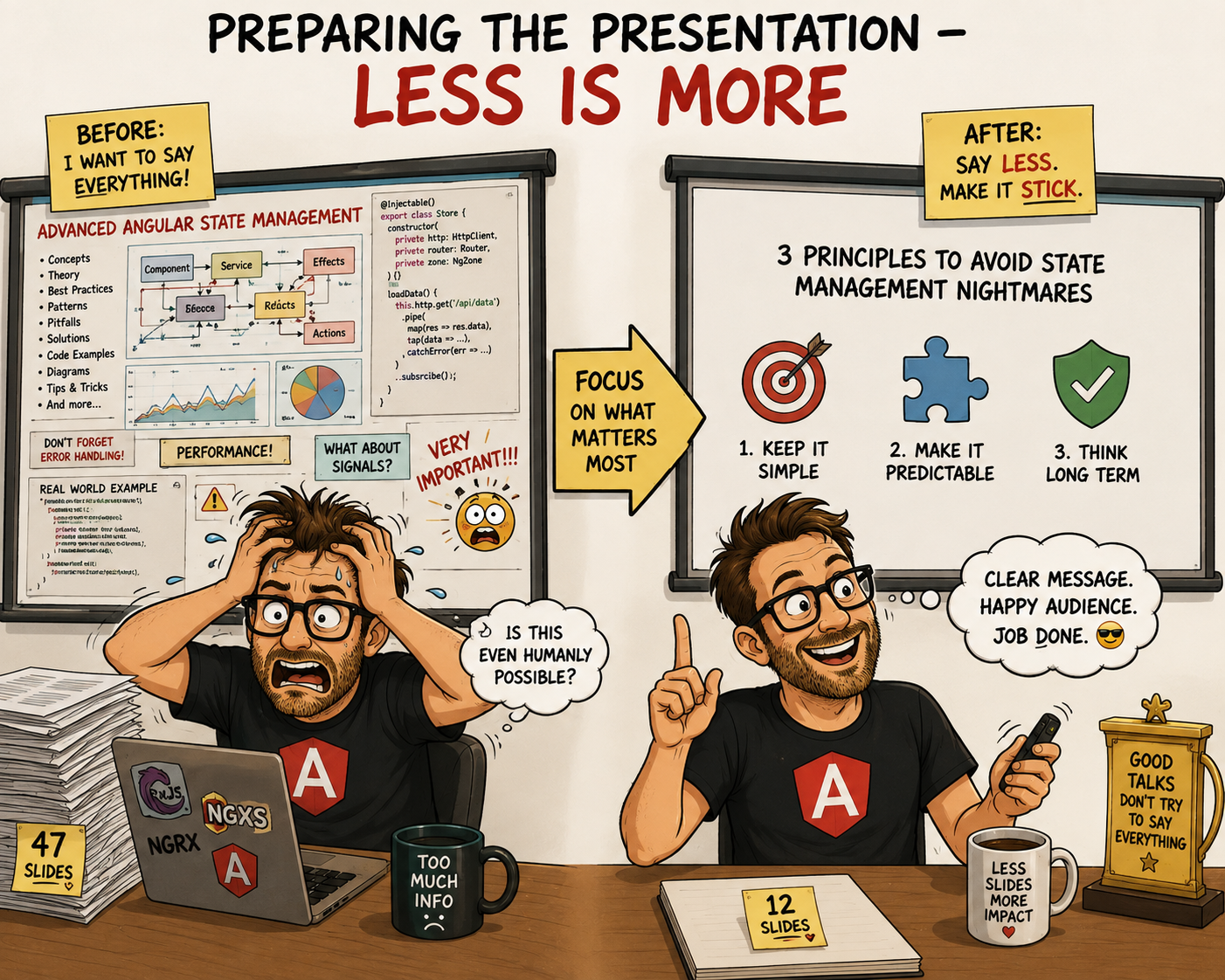
Receiving the acceptance notification for my first international event brought a wave of euphoria and then immediate panic. With a set date and an audience of hundreds, I made a typical rookie error: attempting to condense my entire expertise into one deck. My initial slides were cluttered with dense paragraphs and complex diagrams.
Constructive feedback from veteran speakers steered me right. It became clear that any audience would be overwhelmed by an information overload in a short forty-five minute frame. My goal shifted to saying less, but ensuring the key points endured.
I restarted with a new method: distilling my presentation down to a core set of three fundamental concepts. Every single slide was then required to serve one of those concepts without exception. This forced some tough cuts, eliminating content I initially valued highly, but the resulting narrative was far more impactful and easier for the audience to follow.
Design Principles - Aiding the Talk, Not Reproducing It
A crucial lesson regarding slide content is their role as visual aids, not your script. If your slides contain the exact same text you’re speaking, you’ve become superfluous. The audience can read silently; your voice is needed to provide narrative and insight.
A simple guideline has served me well: a single concept or a one-line diagram per visual. This approach forces public explanation and fosters a connection with the audience, preventing the common trap of reading verbatim from the screen.
Working with coding examples introduces another layer of difficulty. Through my session at FrontEnd Nation, I grasped that code snippets must be highly curated. Display only the precise lines needed to communicate the idea clearly. Excessive code overwhelms the audience, becoming impenetrable noise. Show five well-explained lines; reject the alternative of fifty disconnected lines.
Refining Through Repetition
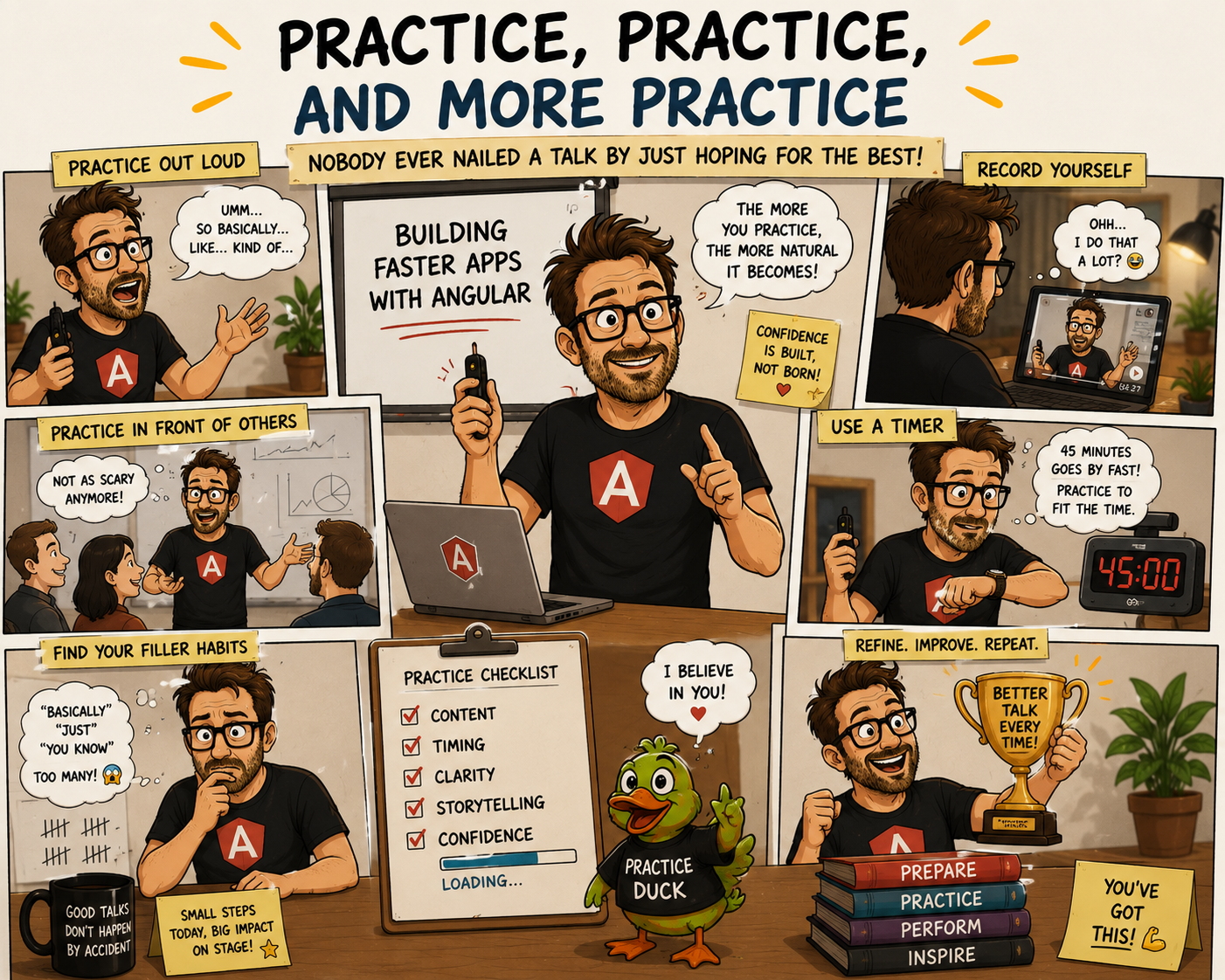
Over-preparation is a myth; you can only benefit from more practice sessions. Before a major event, I’ll mentalize and rehearse frequently. This can involve speaking into a mirror, recording audio especially to study pacing, or presenting to family and colleagues for live results. Each session inevitably surfaces a weakness: a stumbling phrase, a lapse in logic, an unclear example, or a pacing issue.
While incredibly effective, recording myself was an initially painful process. Listening to your own voice forces you to confront your verbal habits. I was shocked to discover my own reliance on filler terms like “kind of” and “basically.” Only by starting to hear them could I possibly eliminate them.
My top piece of advice is to treat smaller, local meetups as a testing ground before a major conference. These environments are far more forgiving. With fewer lights and a less intimidating atmosphere, they allow you to test content and handle Q&A with lower stakes, offering vital data on how your content resonates.
Also, respect the clock. Professional speakers manage themselves within non-negotiable time limits. Knowing my slot ran for exactly forty-five minutes at FrontEnd Nation, I drilled the talk repeatedly until the narrative to fit neatly into that period was apparent.
Day Before Logistics and Stress Management
The final twenty-four hours were often a frenzy of obsessive re-checking for me. I would repeatedly verify my laptop had the presentation, needed adapters were packed, and a plan existed if the primary files failed. Knowing the correct door and room to enter came only after concerted effort.
This may seem excessive, but the costs of an unforced error are too high: discovering a technical fault in the liminal minutes before you’pensil' to go live ensures a nightmare. Broken projectors, dead computers and lost files have been common problems I have seen. Most of these issues are preventable elements of preparedness that should be considered mandatory steps.
I have made it a rule not to touch the presentation on the final day. Long nights of review will not save you or improve a deck at this point; they only induce fatigue. A rested speaker is energetic on stage, which outranks the minimal returns of one last round of edits.
Commanding the Opening Minutes
Walking on stage during DevDays Europe still feels recent. An intense pressure came from facing hundreds of eyes, glaring lights, and adrenalin. However, I now tell myself wisdom from a veteran speaker:
your behaviour during the contesting first 30 seconds can mark the entire delivery.
You need to set that tone yourself. If you deliberately launch with confidence, the entire deck feels easier to navigate. Instability at the start can cause a feeling of constantly fighting against yourself.
This is why the opening words are meticulously scripted in my mind. The opening of a talk is no place for improvisation. I know precisely which lines I will use, and even where my feet will be in the opening standpoints. This anchors my attention and gives some semblance of a measure of calm. Within roughly a golden minute, my higher focus points manage my pulse for good instead of against me as I achieve control.
Another adjustment is the use of eye contact. Without consciously trying, I discovered that the easiest path is panic and staring at ones’ own slides. But an expert approach is to realise a talk must yield a conversational rapport, even if it’s primarily one-way. To that end, I scan the room, targeting their gaze in static moments and briefly holding it with a few. This psychologically strengthens the connection with the person watching.
Approaching Question Time
The Q&A often induced some serious spikes in my stress. What if a query presents itself that I cannot field? What about challenges to my opinion? Eventually, it clicked that a straightforward phrase appears here and becomes a solution. These matters become integral.
"I am not certain, however I’ll explore the topic and update you."
Projecting knowledge where none exists is the major endgame, regardless of charisma. Spectators perceive the facade, making honesty part power and integrity. Demonstrating expertise already communicates awareness rather than ignorance. Confidence comes from talking and confronting the fact you don’t know all points instantly.
Beyond the Stage - Feedback and Building Connections
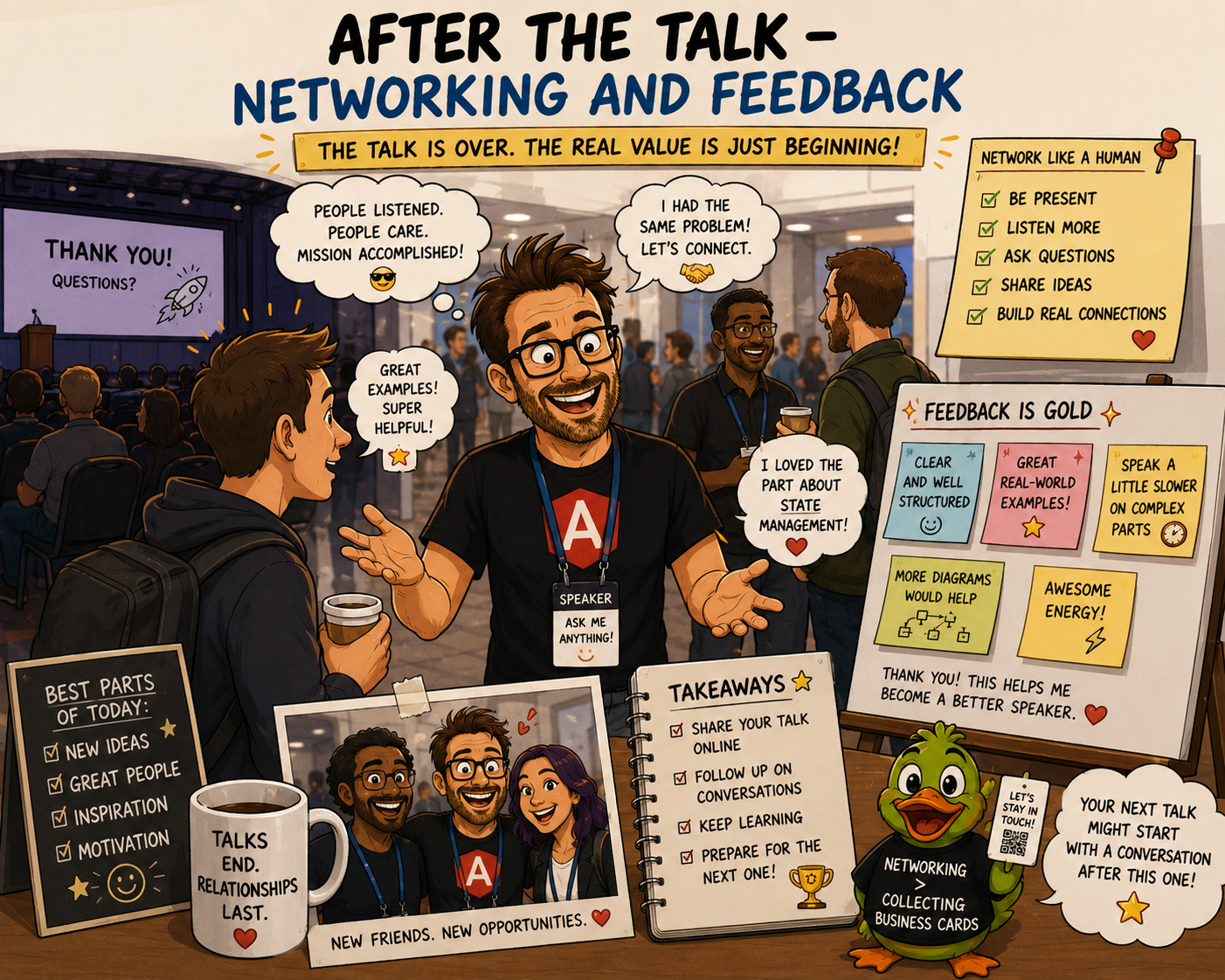
Your time at the mic ends, but full value comes via the conversations afterward. It is also a playing field to connect with the developers who attended your speech. What is found post-talk is that devs will offer their views, perspective, and personal accounts, making these two-way interactions almost worth their weight in gold to me.
Onward, my practice is that receiving constructive forms of critique is mandatory activity. A recommendation from a skilled peer about pacing speed, if a semantic, if your logic reflected that of an non-expert: these are necessary inputs for something truly valuable found inside. An accumulation of various points is the *driving force* for my subsequent events, key to improvement.
Navigating the Reality of Rejection
Of course, the portfolio doesn't always receive approval from program boards or evaluate ‘no’ for one conference. With many prior propositions having received blank rejections and a constant appeal to an unseen judge, initial reactions sometimes fester. Part of familiarity is accepting rejection rate as normal event selection procedure.
Many worthy proposals must be dismissed by enormous caliber pools to have any sense of available stage. But, there may be a mismatch to simply be read into board’s needs as much as effective board decisions shape its cohort. Research and candidate sites in isolation often suffer visibility. Season by season, consistency, the act of not internalizing the rejection letters each iteration carries some measure. Transformation across these repeated communications drives the eventual writing patterns of an effective speaker.
Evaluating the Return on Effort
Constant queries surface concerning the viability of this challenge given the workload we place into it? Colleagues question time-blocking days, multiplied preparation, unexpected travel. Feedback, before the moments feel warranted, is unambiguous: the answer here is resoundingly yes.
This trail has opened links for me and results in lifelong alliances and respected influences or spaces to add credibility through many networks that proved to be meaningful in several astonishing directions.
If you strip all the benefits above away, the mental heavy-lifting done behind this work is alone worth potentially the stage space at all it does, by auditing how much you understand through known clear internal frameworks when structuring for someone tackling this from a "first- principles" stance, never challenging what’idea you think was clear about what everyone knew before is an action shaped in ways to push into better practices from oracles and whatever landscape did this stage you normally enter, whether 1 foot into this display wall or room expansion of scale is formed.
Wrapping Up
If giving a talk is on your "if’ brick, brush it mentally and walk the block that begins it. Starting small yields big yields. Conferences, local presentations – the total sum carried from meet ups and talks usually fills internal terrain. Don’t intend flawless results then. Practically no accepted setup launches that way.
Every speaker chart that line from entering a hall to coming upon it across practice years. Their path generally looks unrefined in the first dozen slots with nuance being ironed through pain, reflection, repetition and real comments for every practice year. Such variation remains your choice to replicate that storyline and its opportunities are leading.