
Global Error Handling in Modern Zoneless Angular: A New Paradigm
Unhandled errors in web applications often act as silent saboteurs. They can subtly degrade user experience, trigger unpredictable behavior, and leave developers unaware of underlying issues. For a long time, Angular's error-handling mechanism has relied on a layer of "magic" supplied by Zone.js. However, as Angular pivots towards a more explicit and performant zoneless architecture, this magic vanishes, necessitating a fresh strategy. This is the core reason provideBrowserGlobalErrorListeners was created. It is more than just another feature in Angular v20; it is an essential component for maintaining robust error handling in the new zoneless world. Let's trace the journey from the old approach to this new solution.
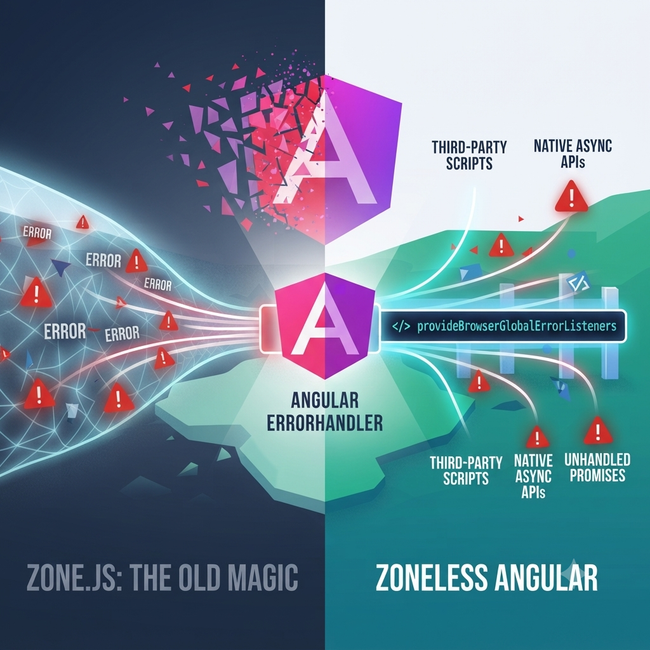
The Zone.js Era: The Convenience of Implicit Interception
In a classic, "Zone-full" Angular setup, Zone.js operates like an invisible observer over the entire application execution context. It achieves this by "monkey-patching" virtually all standard asynchronous browser APIs, including setTimeout, addEventListener, and, most importantly, Promise.
By wrapping these fundamental APIs, Zone.js becomes aware of the lifecycle of almost every asynchronous task. While this mechanism is predominantly used to trigger Angular's change detection automatically, it also provides a significant, albeit incidental, benefit for error handling:
- Automatic Capture: When a
Promiserejects and lacks a.catch()handler,Zone.js's instrumented version ofPromisedetects the failure. It automatically intercepts the unhandled rejection and routes it back into Angular's execution context. - Centralized Processing: As a result, these "external" errors are seamlessly directed to Angular's central ErrorHandler, where they are processed in the same manner as an error thrown by a component or service. The
ErrorHandleris an injectable class that acts as the primary, centralized hook for all exceptions caught within the Angular framework. Its default implementation is quite simple. Further details can be found in Armen's article on Angular Error Handling.
This was incredibly convenient, yet it depended entirely on the implicit and pervasive nature of Zone.js.
The Zoneless Hurdle: Navigating Without the Safety Net
By definition, a zoneless application does not include Zone.js. This choice yields significant performance improvements and clarifies application behavior, but it also removes the invisible error-catching net that developers had come to rely on.
So, what transpires when an error originates outside of Angular's direct purview in a zoneless environment? Consider these frequent situations:
- Promise Rejections Without Handlers: A
Promiserejects somewhere in the codebase, but no.catch()handler was chained to it. - Errors in Third-Party Code: A non-Angular library, perhaps one that manipulates the DOM or handles its own async operations, encounters an error.
- Callback Exceptions: A callback function passed to a native browser API, such as
setTimeout, or an event listener added viaaddEventListener, throws an uncaught error.
Without a dedicated mechanism in place, these errors would bypass Angular's ErrorHandler. They would be logged to the browser console, but they would remain outside the centralized error-handling logic, and therefore invisible to logging and reporting services.
The New Approach: Bridging the Gap with provideBrowserGlobalErrorListeners
This is the exact challenge that provideBrowserGlobalErrorListeners was designed to address. It acts as the explicit and modern replacement for the implicit capabilities that Zone.js offered for error handling.
Instead of patching existing APIs, this provider sets up straightforward, native event listeners on the window object for these two specific global events:
- error: This event fires for general runtime script errors.
- unhandledrejection: This event fires whenever a
Promiseis rejected and there is no handler to catch the rejection.
When one of these global events is triggered, the listener created by provideBrowserGlobalErrorListeners captures the raw error and **transmits it to Angular's centralized ErrorHandler class.
This action re-establishes the crucial link that was severed when Zone.js was removed, creating a unified pipeline. This ensures that errors originating from third-party scripts, native browser APIs, or unhandled promises are handled with the same rigor as errors thrown from within Angular components or services. Consequently, all errors can be managed in a single, central location—whether the goal is logging, analytics, or presenting user-friendly notifications.
The function is a standard part of Angular's default setup. When a new project is generated via the Angular CLI, the provideBrowserGlobalErrorListeners() provider is automatically included in the app.config.ts file, guaranteeing that a baseline of robust error handling is present from the start.
export const appConfig: ApplicationConfig = {
  providers: [
    provideBrowserGlobalErrorListeners(),
    // ...
  ]
};
Testing Considerations and Impacts
This improved error capture has a significant effect on testing. Errors thrown within event listeners are now reported to Angular's internal error handler. This is beneficial for application quality, as tests may now surface errors that were previously unreported, thereby exposing hidden bugs.
The optimal strategy is to address and fix the root causes of these errors in the test code. If that is not immediately practical, a fallback option exists. In the configureTestingModule setup, the TestBed can be configured to prevent these errors from breaking the test suite by setting rethrowApplicationErrors: false as a temporary measure:
TestBed.configureTestingModule({
  // ... other testing module configuration
  rethrowApplicationErrors: false, // Use only when necessary
});
Flexibility and Recommended Practices
The Angular team recommends that most applications handle these global errors, and provideBrowserGlobalErrorListeners is the most straightforward method to accomplish this. It provides a "plug-and-play" solution that works harmoniously with the framework.
Nevertheless, Angular does not force a single approach. Should an application have unique requirements that call for a different strategy, custom listeners for window.error and window.unhandledrejection can be implemented. In such a scenario, it is both possible and advisable to remove provideBrowserGlobalErrorListeners from the app.config.ts providers to prevent the setup of duplicate handlers.
Wrapping Up
provideBrowserGlobalErrorListeners is a powerful and practical utility for Angular development. It provides a consistent method for capturing errors that take place beyond the Angular context, smoothly incorporating them into the framework's error-handling pipeline. As Angular's architecture evolves, the need to explicitly manage errors becomes increasingly critical. By utilizing provideBrowserGlobalErrorListeners alongside custom ErrorHandler implementations, Angular applications will be more resilient, predictable, and user-centric.