Updated twice, on June 13th and June 22nd – see the updates at the bottom.
I was among those who misinterpreted Anthropic's recent strategy with Mythos – now formally known as Mythos 5. For months, they withheld it from the public, granting access only to Project Glasswing partners. My guess was that this was purely promotional: the model would outperform its predecessors, no doubt, but the narrative around it felt inflated. Their talk about installing safeguards and guardrails first – framed as protection against malicious use – struck me as a convenient justification. I suspected the genuine reason was a shortage of compute, given that this new model demands substantially more tokens and enormous processing power.
That assumption turned out to be mistaken.
The safeguards were far from a pretext: via Project Glasswing, close to 200 vetted entities across over 15 countries have been examining mission-critical codebases – covering power, water, healthcare, and communications – using the Claude Mythos Preview, uncovering more than 10,000 high- or critical-severity security vulnerabilities. And compute wasn't the limiting factor either. What the public release actually needed was a new set of safety classifiers – spanning cybersecurity, biology, chemistry, and distillation efforts – which in flagged sessions now reroute affected queries to Opus 4.8.
My blog series on AI coding traces back to early December – exactly six months ago, just weeks after Opus 4.5 came out. In my own experience, that release marked a turning point: it was the first model with which I could genuinely write – or more precisely, craft through prompts – code. I may come across as opinionated, but I have strong views on what quality code should look like. With Opus 4.5, I encountered the first model that produced code indistinguishable from my own: same standards, same style, same architectural choices. Before that, I was convinced agentic tools merely generated junk. Six months ago, I was proven wrong.
Now I held the same skepticism toward the Mythos buzz – and once more, I was proven wrong. On June 9, 2026, Anthropic unveiled Fable 5 to the public – the same underlying engine as Mythos 5, now equipped with the new protections. This is not merely an incremental upgrade. It's a new class of LLM, and its capabilities are genuinely remarkable.
It can handle every task you'd previously delegate to GPT 5.5 or Opus 4.8 – but it does so with superior results, showing a consistency and polish I've never witnessed before. I'll admit it plainly: it writes better code than I do. That isn't to say my role is redundant. The model still depends on a capable, experienced web developer to guide it toward a high-caliber outcome. And delivering high-caliber code remains my constant objective, whatever the project or environment.
To be honest, I hadn't planned to cover model updates in this series, especially not within the first few months – the constant hype posts and videos exhaust me. But given what I consider a genuine generational shift, I felt compelled to address it. Yesterday, Manfred questioned my reasoning for deeming this a new generation, and I struggled to articulate it on the spot. My response was: "Give me a day to think it through. I'll get back to you – perhaps with a blog post on the topic."
Consider this that post.
Why Does Fable 5 Represent a Leap Forward?
A key indicator that Fable 5 ushers in a new era is the caliber of the code it produces. The output isn't merely above average – it's exceptional. It adheres to established best practices, maintains logical organization, stays clean, and reads as if a proficient senior engineer had authored it. This marks a significant improvement over prior models. In my own testing, I had it scrutinize work I'd previously completed with GPT 5.5 and Opus 4.8 – it quickly identified bugs, blockers, and latent concerns. It also excelled at simplification tasks when I asked for refactoring. In essence, it's versatile across the board.
Here's a non-exhaustive rundown of what makes Fable 5 stand out:
- Long-horizon autonomy: Anthropic claims Fable 5 sustains focus on a single problem for far longer than any previous model, working without supervision for days. Andrej Karpathy describes it as a shift comparable to what Opus 4.5 triggered back in November – particularly for extended problem-solving on exceptionally tough challenges. I share his view, and that's precisely why I'm writing this. With Fable 5, you direct it at a problem, not at a file.
- Vague goals in, validated results out: give it an instruction as broad as "explore options to boost performance here," and it will generate hypotheses, run experiments – even build its own fuzzers and test setups – then return with tested findings, not mere speculation. Skills and elaborate prompt engineering are no longer prerequisites – though I'll venture a guess: they'll gain prominence once more when token costs become the dominant concern.
- Token efficiency despite the price tag: at roughly €10 per million input and €50 per million output tokens (official pricing is in US dollars; converted to euros and rounded up a bit), it runs about two times the per-token cost of Opus 4.8. Yet it consumes far fewer tokens per task, so on DeepSWE – still my go-to coding benchmark – early figures place it roughly alongside GPT 5.5 while surpassing every Opus result at a lower total expense. Artificial Analysis has already put the new model through their coding-agent adaptation of DeepSWE (see the chart below), and the official DeepSWE leaderboard now mirrors that outcome from the source itself.
- Benchmark jump: on the Artificial Analysis intelligence index, it now ranks as the most capable model ever recorded, roughly five points ahead of GPT 5.5 – one of the most substantial single leaps in recent memory. As always: indicators, not definitive judgments.
- Vision: Anthropic has, for the first time, taken the vision crown from OpenAI. For our field, that's more consequential than it appears – consider screenshot-driven visual validation of Angular components, or design work that shows real aesthetic judgment instead of recycled patterns.
- Not just coding: Anthropic deliberately positions it for finance, research, economics, and law – and initial evaluations confirm its writing is notably less boilerplate AI-speak than what we've seen before.
Building on that final point, I'd include design and communication – anything from brief emails to comprehensive project blueprints. It excels across all of these. It follows your instructions, walks you through the steps of whatever you're tackling, and returns with thoughtful suggestions for advancing toward your objective.
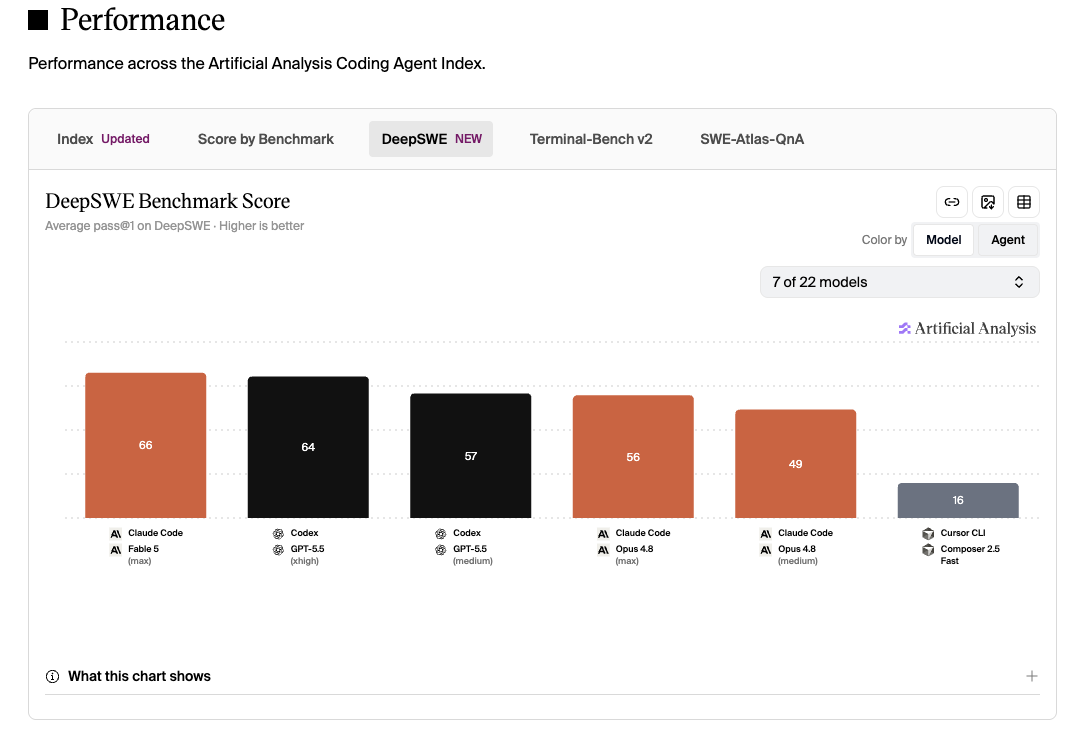
DeepSWE results for today's leading coding agents, gathered June 12, 2026 – follow the chart to access the live version. These are coding-agent metrics, so the harness plays a role: Fable 5 operates within Claude Code at max effort here. A useful advantage of this perspective is that it even covers Composer 2.5, which the standard DeepSWE leaderboard couldn't assess due to the lack of a public API.
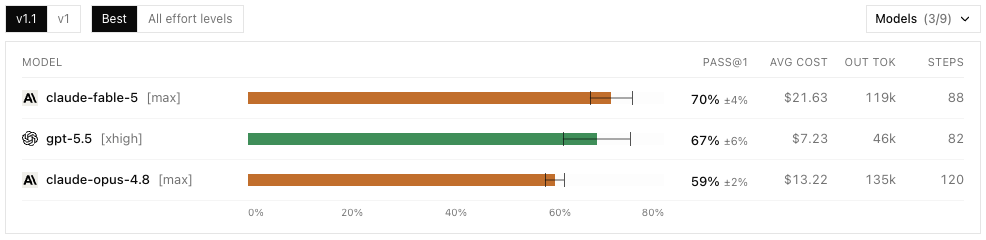
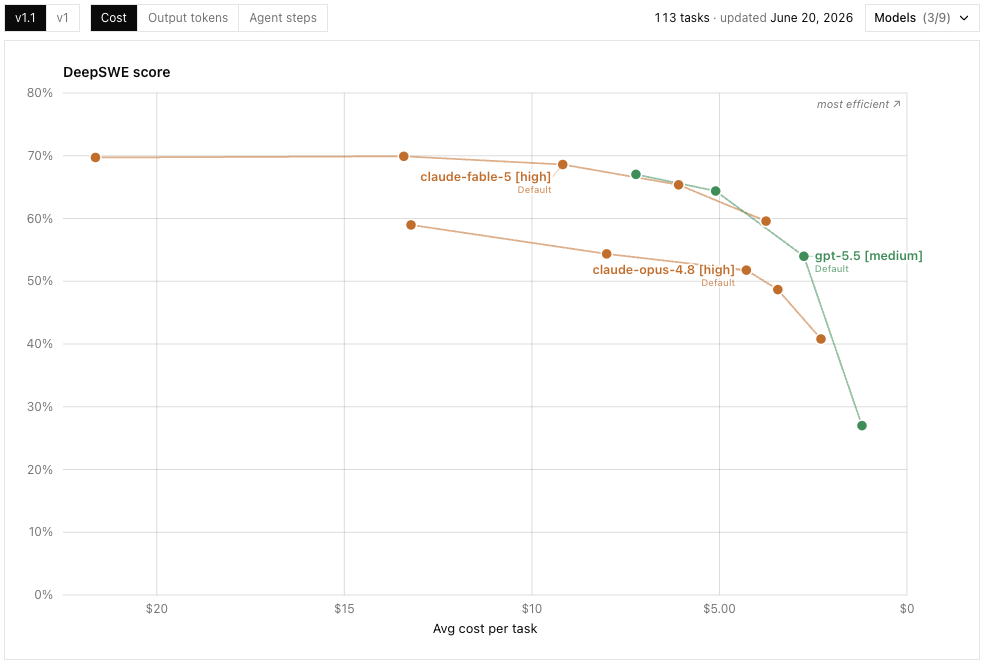
The official DeepSWE rankings, updated June 20, 2026, show Fable 5 at 70% pass@1 on v1.1, edging past GPT 5.5's 67% and comfortably ahead of Opus 4.8's 59%. The cost perspective is a key caveat: Fable 5 proves the strongest model in this sample, but not the most economical, so my advice is to reserve it for demanding, multi-stage engineering tasks where added quality genuinely shifts the result.
So this model lives up to the hype – perhaps even exceeds it. Which naturally prompts the question: so what's the downside?
Every Fable Has Its Fine Print
It isn't just one catch — there are several. Some are mildly inconvenient, while others could rule this model out entirely depending on your environment.
The safeguards are real, and you will feel them. Anthropic reports that fewer than 5% of sessions get routed to Opus 4.8, and my coding experience so far aligns with that — I haven't encountered a single refusal yet. However, Artificial Analysis observed fallback routing in 8% of their benchmark tasks, particularly on scientific queries. At least the mechanism is transparent: when it happens, you're informed.
One safeguard operates without any warning, though. When Fable 5 detects that you're engaged in frontier LLM development, it doesn't tell you — instead, it quietly reduces its own capabilities through prompt modification, steering vectors, and parameter-efficient fine-tuning. Anthropic estimates this impacts 0.03% of traffic and fewer than 0.1% of organizations, so most Angular developers will never run into it. Still, paying full price for a model that's silently downgraded sets a precedent I genuinely dislike.
Zero data retention is not an option. Every Fable 5 interaction requires 30-day retention — even for enterprise customers, with no way to opt out. Anthropic states the data isn't used for training or any non-safety purposes, but as I noted in the data privacy post: "not used for training" doesn't mean "not retained". For regulated industries and strict corporate policies, that alone can be a deal-breaker.
Now for the three catches that hit all of us directly:
The clock ran out sooner than anyone expected. Fable 5 was effectively in my hands only from June 10 through June 12, 2026. My original write-up predicted the included window would last until June 22 and then shift to usage credits. That turned out to be way too optimistic: on June 12, Anthropic was forced to switch off Fable 5 and Mythos 5 for everyone following a US government directive. For roughly three days, we had a look at the next generation — and then it vanished.
It's slow. Even straightforward tasks take one to three minutes, and I've rarely seen a run complete any faster. This isn't a model for the tight interactive loop where Composer 2.5 or GPT 5.5 on low reasoning excel. But as I made the case in the costs post, the relevant speed metric isn't tokens per second — it's the end-to-end time until I have a reviewed diff. For long autonomous runs, Fable 5's pace is fine. For quick edits, look elsewhere.
It's pricey. At roughly €10 input and €50 output per million tokens, it costs about double what Opus 4.8 charges, and the usage limits drain accordingly: early adopters report burning through roughly €100 of usage-based inference in under ten minutes, and exhausting the 5-hour session limits of two €200 subscriptions in a single evening. Yes, it needs fewer tokens per task, so the cost per accepted, reviewed, merged change can still win out on hard problems. But for routine edits, this model is simply excessive — and after June 12, pricing became moot because it was no longer available.
So my original call to action didn't age well: we didn't have until June 22. We had June 10 to June 12, and then the model went dark. If you managed to test it in that brief window, you caught a preview of what a next-gen model can do on a real codebase. If not, we're all left wondering whether Anthropic can bring it back.
My Updated Current Setup
In my personal verdict, published less than two weeks ago (in early June 2026), my default was Codex with GPT 5.5, complemented by the Claude Desktop app with Opus 4.8 for architecture, design, refactoring, and reviews. Three days of Fable 5 have flipped that balance completely:
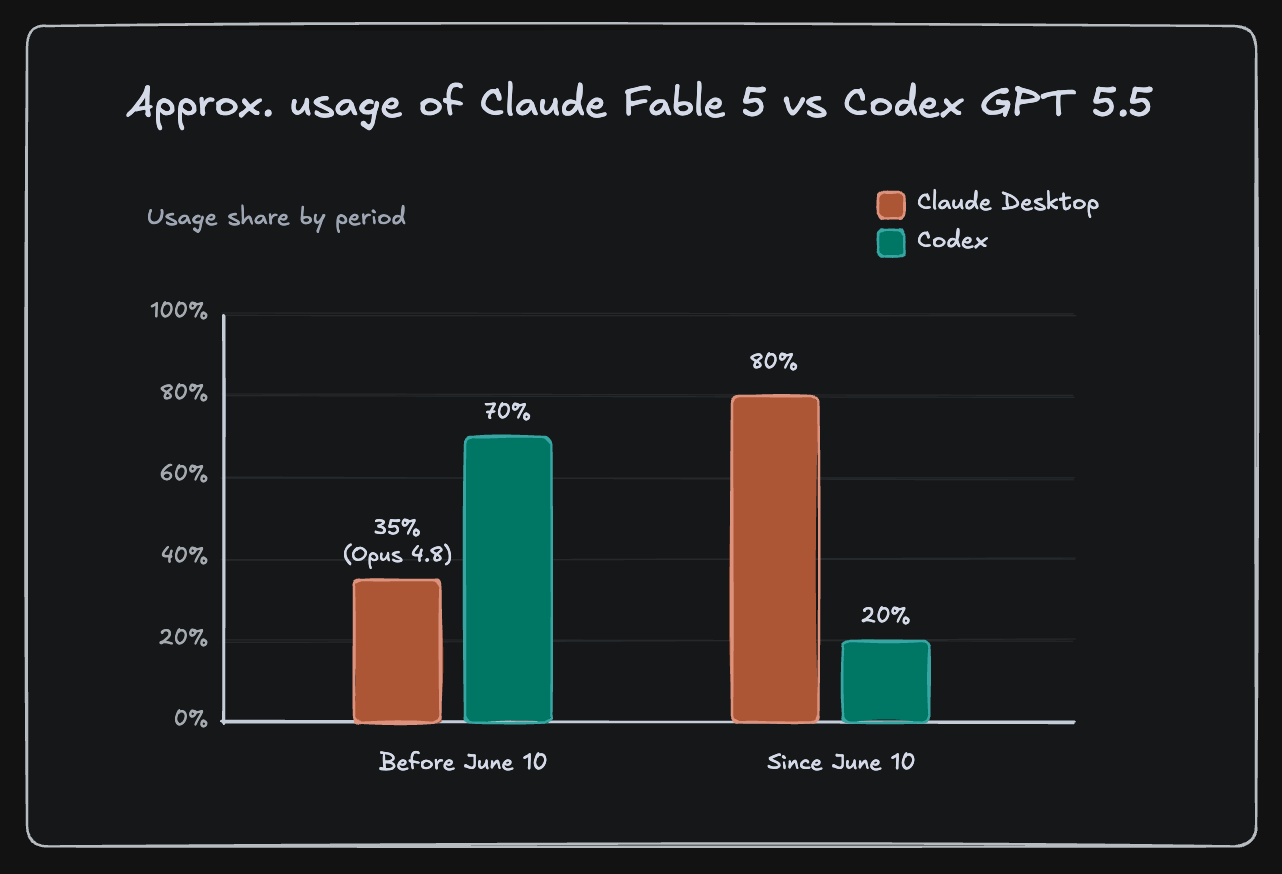
- Before June 10: Codex with GPT 5.5 was my primary tool (70%), while the Claude Desktop app with Opus 4.8 covered architecture, design, refactoring, and reviews (35%).
- From June 10 to June 12: the Claude Desktop app with Fable 5 handled 80% of my work, with Codex and GPT 5.5 taking the remaining 20%.
Careful readers of that verdict will recall why my old percentages summed to more than 100%: I used to cross-check each app's output with the other contender. That habit has largely stopped now — there's simply no point in reviewing Fable 5's results with GPT 5.5, because Fable 5 is clearly superior.
I still lean on Codex for computer use, image generation, and quick tasks that need to be done fast — exactly the kind of work where Fable 5 would be wasted. And I'm keeping my OpenAI subscription active, because I suspect we'll soon see GPT 6 as the counter to Fable.
So the decision tree from the personal verdict still holds — but the top branch has a different label now, at least for the moment.
Human in the Loop – for How Much Longer?
Right now, the agentic engineering community splits into two broad camps.
The first camp is the progressive one. Their stance: "Just trust the coding model. You don't need to review its output anymore — human review has become the bottleneck." A good number of my friends sit here.
The second camp argues: "You still have to review everything the model produces, because that's the only way to keep slop from creeping into your codebase." If you've followed this series, you know where I stand: in the apps and harnesses post, I stated that I scrutinize every diff and demand that each generated line look handcrafted, and the later harness setup post translates that idea into concrete guardrails. Many of my colleagues sit in this camp. Some of them are still struggling to find time to even attempt agentic engineering. Hard to believe, right?
I was fully committed to the human-in-the-loop (HITL) position. The last two days have shaken that conviction considerably.
Not because my standards slipped, but because the review dynamic reversed: as I described above, I had Fable 5 assess work that GPT 5.5, Opus 4.8, and I had collaborated on — and it spotted the bugs, the issues, and the simplifications, not me. When the model reviews my output more effectively than I review its output, the debate stops being about whether human review is sacrosanct. The real question becomes what it still catches.
So here's the uncomfortable statement I never expected to make this soon: I can foresee human reviews actually becoming obsolete in the near future — not due to laziness, but because they stop surfacing anything the model hasn't already identified itself.
For the time being, my workflow hasn't changed: every diff still gets my eyes on it, and that remains my recommendation to every professional Angular team. But for the first time, this feels less like a timeless principle and more like a practice with an expiration date. Check back with me in six months. Or even three. We'll see. Exciting times!
Agentic Engineering Workshop
And this is precisely why a new model — even a whole new generation — doesn't alter the fundamentals: the model, the app, my Angular Guardrails, my Angular Coding Style Guide, and the review workflow still form a single system. Fable 5 just raised the ceiling for what that system can accomplish.
If you want to evaluate new models like Fable 5 on your own codebase — and deploy them for genuine modernization, refactoring, testing, and review work — join our Agentic Engineering Workshop, offered in English and German. There, advanced Angular developers learn to move from vibe coding to traceable Agentic Engineering workflows: AI-ready project setup, guardrails, spec-first and plan-first approaches, UX and component prototyping, code review, testing, and brownfield refactoring.
- 🤖 Agentic Engineering Workshop – 2 days, remote
Conclusion
Half a year ago, Opus 4.5 persuaded me that agentic tools can produce real code. Fable 5 is the first model since then to give me that same sense of crossing a threshold — not due to benchmark numbers, but because of what it does in my everyday work: it sticks with a difficult problem, it checks its own work, and it writes code I genuinely like and want to merge.
In the first post of this series, I argued that benchmark wins are useful indicators, not conclusive proof, and that no single release should trigger an overnight workflow overhaul. I still hold that view — yet Fable 5 is the first release that pushed me to revise my setup within days, and the first that made me question my own human-in-the-loop principle. Both things can be true at once: remain wary of the hype, and recognize a new generation when it shows up in your terminal.
The drawbacks are genuine: the safeguards, the data retention, the latency, the cost, and above all the June 12 shutdown. So let me correct my original call to action one final time: the included Fable 5 window didn't close on June 22; it ended on June 12, 2026, when Anthropic pulled access following the US government directive. If it returns, assess it the same way I've recommended for every previous model — on your own codebase, with your own tasks, your own tools, and your own review criteria.
One final admission: this is my first model-release hype post — exactly the kind of content I claimed to be tired of at the outset. I hope I don't have to write another one anytime soon. Although, there will probably be one when GPT 6 arrives — let's see how quickly OpenAI responds.
Thank you for reading 🙏 this blog post was written by Alexander Thalhammer. For feedback, remarks or questions, please reach out to me ❤️
Update June 13th
So here's the real catch: the model was taken offline by the US government. Genuinely disappointing. What a loss. The AI conflict has escalated — let's see where things go from here. For now, we're back to doing more of the heavy lifting ourselves.
Update June 22nd
Added new charts from DeepSWE dated June 20th. Still awaiting the model's return.