What Exactly Sets Fable 5 Apart?
The most immediate difference is the sheer quality of the generated code. This isn't merely "good" code—it's production-grade, well-structured, and adheres to best practices as if a seasoned senior developer had written it. The leap forward from earlier models is substantial. When I fed it some of my previous work done with GPT 5.5 and Opus 4.8, it quickly isolated bugs, subtle issues, and potential improvements. It also handled refactoring with the same finesse. In short, it's a versatile tool that can handle virtually any task. Here’s a rundown of its most impressive attributes, though this list is by no means exhaustive:- Sustained autonomy for complex tasks: Anthropic claims Fable 5 can stick with a problem far longer than any predecessor, working autonomously for days. Karpathy has described this as a step change on par with the introduction of Opus 4.5, especially when tackling exceptionally difficult, long-running problems. This assessment resonates with my own experience. You don't point this model at a specific file; you point it at an entire problem.
- From vague instructions to verified outcomes: You can give it an ambiguous directive like "explore ways to improve performance," and it will independently generate hypotheses, set up its own fuzzers and test environments, and return with data-backed results rather than educated guesses. While intricate prompt engineering and specialized skills are less critical now, I suspect they will regain importance in the future when token efficiency becomes the primary concern.
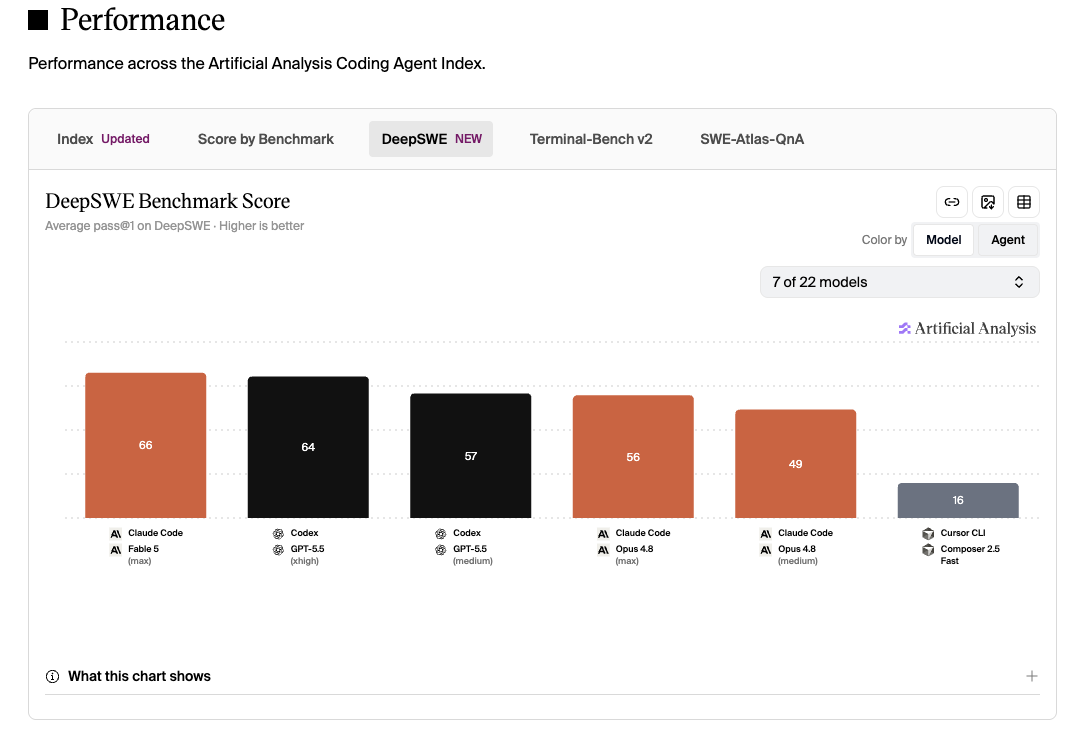
- Efficiency despite the premium price: At roughly €10 per million input tokens and €50 per million output tokens (pricing is listed in USD, so I've converted and rounded up for simplicity), Fable 5 costs about twice as much per token as Opus 4.8. However, it requires significantly fewer tokens to complete a task. On benchmark tests like DeepSWE—which remains my go-to for measuring coding capability—early results show it performing at a level comparable to GPT 5.5, while surpassing every Opus score at a lower overall cost. Independent analyses from Artificial Analysis using their coding-agent version of the DeepSWE test corroborate the official leaderboard findings.
- Significant benchmark advancements: On the Artificial Analysis intelligence index, it has achieved the highest score ever recorded, sitting roughly five points ahead of GPT 5.5—one of the largest leaps we've seen in recent history. Consider these numbers as strong indicators, not definitive proof.
- Superior vision capabilities: For the first time, Anthropic has taken the lead over OpenAI in vision technology. This is more impactful than it may seem for our work, enabling screenshot-based verification of Angular components and fostering genuine design creativity rather than relying on generic templates.
- Broad applicability beyond coding: Anthropic is positioning this model for finance, research, economics, and law. Early feedback also suggests that its written output is noticeably less formulaic—less "LLM slop," as some call it—than what we've seen previously.
 The chart above, captured on June 12, 2026, displays DeepSWE scores for the leading coding agents—click it to see the live, up-to-date comparison. Technically, these results reflect the performance of the coding agent itself, so it's worth noting that Fable 5 is running within Claude Code at maximum effort here. An added bonus of this setup is that it includes data for Composer 2.5, which the official DeepSWE leaderboard couldn't evaluate due to its lack of a public API.
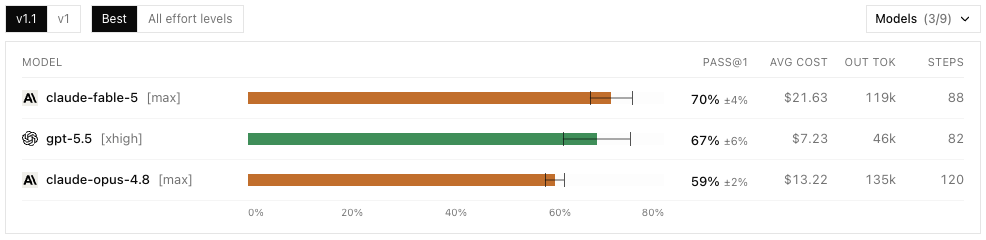
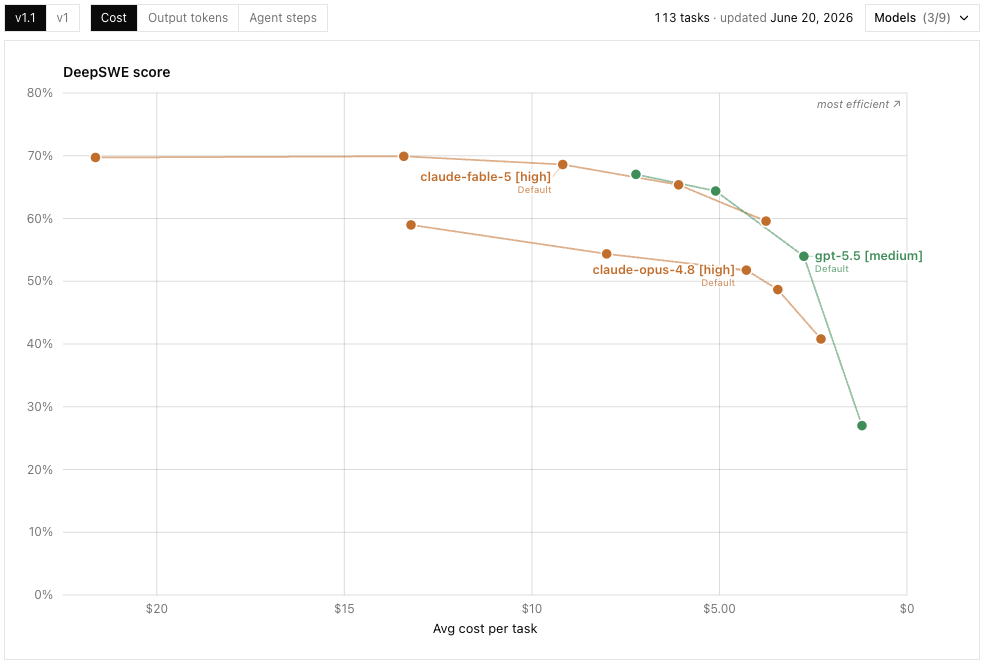 The official DeepSWE leaderboard, as of June 20, 2026, now ranks Fable 5 at a 70% pass@1 rate on version 1.1, narrowly edging out GPT 5.5's 67% and comfortably surpassing Opus 4.8's 59%. However, the cost data is a crucial caveat. Fable 5 is the most powerful model in this comparison, but it's not the most economical. I'd reserve it for demanding, long-horizon projects where the superior output quality justifies the additional expense.
This model is, without exaggeration, exceptionally capable—almost unreasonably so. That brings us to the inevitable question: what's the catch?
The official DeepSWE leaderboard, as of June 20, 2026, now ranks Fable 5 at a 70% pass@1 rate on version 1.1, narrowly edging out GPT 5.5's 67% and comfortably surpassing Opus 4.8's 59%. However, the cost data is a crucial caveat. Fable 5 is the most powerful model in this comparison, but it's not the most economical. I'd reserve it for demanding, long-horizon projects where the superior output quality justifies the additional expense.
This model is, without exaggeration, exceptionally capable—almost unreasonably so. That brings us to the inevitable question: what's the catch?
The Fine Print Behind Every Fairy Tale
There isn’t just one hidden condition here—there are several, ranging from mildly inconvenient to potentially disqualifying depending on your infrastructure.
The protective measures are tangible, and you’ll definitely notice them. Anthropic claims that under 5% of sessions are redirected to Opus 4.8, and my personal coding experience aligns so far—I haven’t encountered a single refusal yet. However, Artificial Analysis recorded fallback routing in 8% of their test scenarios, primarily on scientific queries. At least the process is visible: whenever it happens, you’re informed.
But one safeguard operates invisibly. When Fable 5 identifies that you’re engaged in frontier LLM development, it doesn’t alert you—it quietly restricts its own capabilities through prompt alteration, steering vectors, and parameter-efficient fine-tuning. Anthropic estimates this impacts 0.03% of traffic and fewer than 0.1% of organizations, so the vast majority of Angular developers will never encounter it. Nevertheless, paying full price for a model that silently limits itself sets a precedent I genuinely dislike.
Zero data retention doesn’t exist. Every Fable 5 interaction mandates 30-day retention—even for enterprise clients, with no opt-out provision. Anthropic insists the data isn’t utilized for training or other non-safety objectives, but as I noted in the data privacy article: “not used for training” doesn’t equate to “not stored.” For sectors under strict regulation and organizations with rigid policies, this issue alone can be a deal-breaker.
Now, let’s examine the three catches that impact all of us directly:
The countdown ran faster than anticipated. Fable 5 was practically at my disposal only between June 10 and June 12, 2026. My initial write-up suggested the included access period would extend to June 22, followed by usage credits. That projection proved overly optimistic: on June 12, Anthropic was compelled to disable Fable 5 and Mythos 5 for everyone following a US government directive. For about three days, we witnessed the next generation—and then it vanished.
It operates slowly. Even routine assignments take one to three minutes, and I’ve rarely seen a run complete faster. This isn’t suited for the tight interactive loop where Composer 2.5 or GPT 5.5 on low reasoning settings perform well. Yet, as I argued in the costs article, the meaningful speed metric isn’t tokens per second—it’s the overall duration until I’ve examined a final diff. For extended autonomous executions, Fable 5’s tempo is reasonable. For rapid adjustments, turn to alternatives.
It commands a premium. At roughly €10 input and €50 output per million tokens, that’s approximately double the Opus 4.8 rate, and the usage quotas deplete correspondingly: early users report consuming about €100 of metered inference in under ten minutes, and exhausting the 5-hour session caps of two €200 subscriptions in a single evening. Indeed, it demands fewer tokens per task, so the cost per accepted, reviewed, merged change can still be favorable for complex challenges. But for routine edits, this model is simply excessive—and after June 12, its pricing was moot since it was no longer available.
Consequently, my earlier call to action didn’t age well: we weren’t granted until June 22. We had June 10 through June 12, and then the model was terminated. If you evaluated it during that narrow span, you caught a preview of what a next-gen model can accomplish on an actual codebase. If not, we’re all left waiting to see whether Anthropic can restore it.
My Revised Current Workflow
In my personal assessment, released under two weeks ago (in early June 2026), my standard setup was Codex with GPT 5.5, supplemented by the Claude Desktop app with Opus 4.8 for architecture, design, refactoring, and reviews. Three days of Fable 5 have completely inverted that distribution:
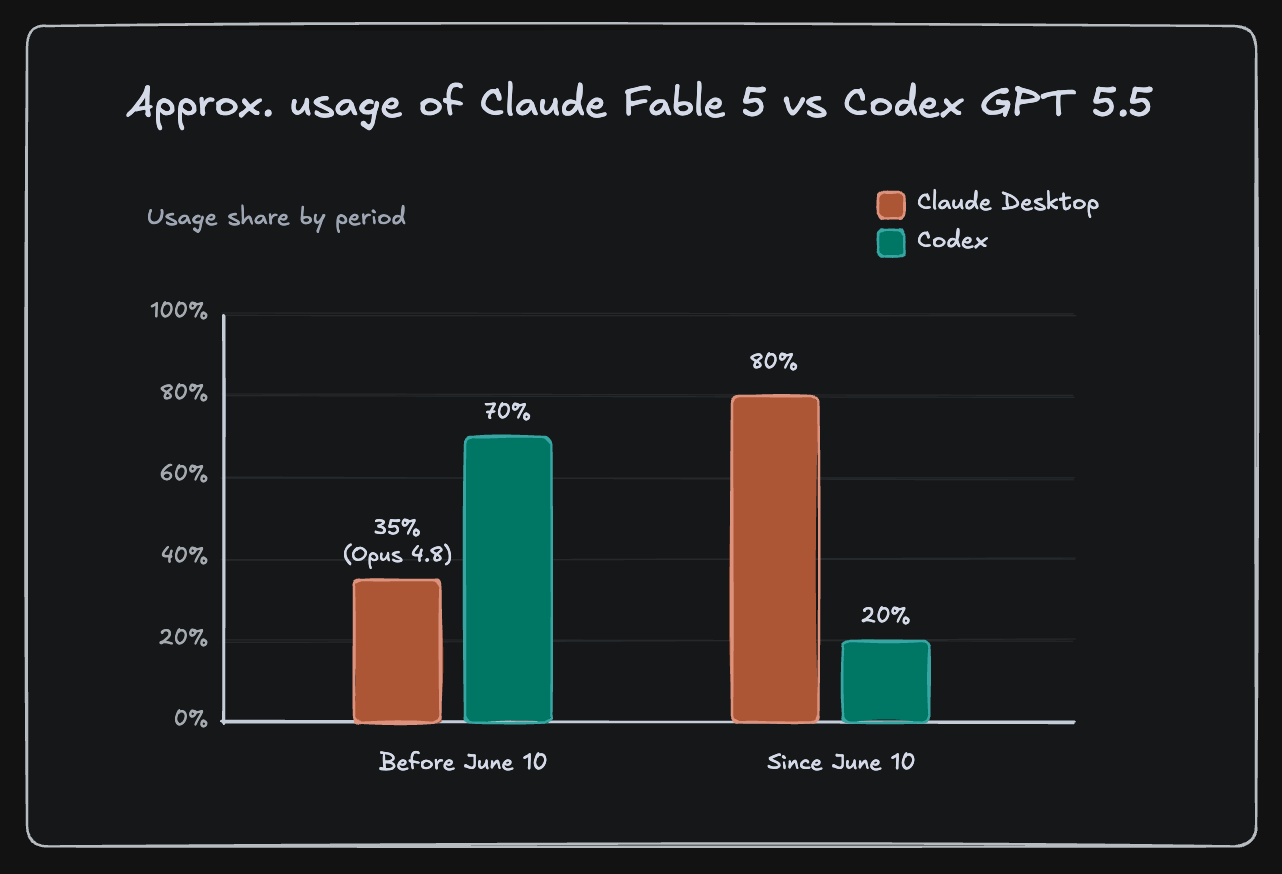
- Prior to June 10: Codex with GPT 5.5 served as my primary (70%), while the Claude Desktop app with Opus 4.8 managed architecture, design, refactoring, and reviews (35%).
- From June 10 to June 12: the Claude Desktop app with Fable 5 handled 80% of my workload, with Codex and GPT 5.5 taking the remaining 20%.
Sharp readers of that assessment will recall why those old percentages exceeded 100%: I used to cross-check the outputs of each primary app with the other challenger. That habit has essentially ceased now—there’s simply no need to validate Fable 5’s results with GPT 5.5, because Fable 5 is fundamentally superior.
I still rely on Codex for computer usage, image generation, and straightforward tasks that need rapid execution—precisely the category where Fable 5 would be squandered. Nor am I canceling my OpenAI subscription, since I anticipate GPT 6 as the counter to Fable arriving soon.
Thus, the decision framework from the personal assessment remains valid—but its highest branch now carries a new designation, at least temporarily.
Human Oversight—For How Much Longer?
The agentic engineering field currently splits into two distinct factions.
The first group takes a forward-looking stance. Their argument: “Simply trust the coding model. You don’t need to scrutinize its output anymore—human inspection is now the limiting factor.” Many of my peers belong to this camp.
The second group counters: “You must verify everything the model generates, as that’s the sole method to prevent slop from infiltrating your codebase.” If you’ve followed this series, you know which side I’ve aligned with: in the apps and harnesses post, I stated that I examine every diff and expect each generated line to appear as though I’d handcrafted it myself, and the subsequent harness setup article converts that notion into practical safeguards. Numerous colleagues sit in this camp—some of them still struggling to allocate time for trying agentic engineering at all. Unbelievable, right?
I was wholly committed to the human-in-the-loop (HITL) philosophy. The past couple of days have made me significantly less certain.
Not because my expectations slipped, but because the review dynamic reversed: as detailed above, I had Fable 5 examine work that GPT 5.5, Opus 4.8, and I had jointly produced—and it uncovered the defects, the concerns, and the reductions, not me. When the model reviews my output more dependably than I review its own, the debate shifts from whether human inspection is essential to what it can still detect.
So here’s the uncomfortable admission I didn’t anticipate making so early: I can envision human reviews genuinely disappearing in the near term—not due to complacency, but because they cease to surface anything the model hasn’t independently caught.
At present, though, I haven’t altered my routine: every diff still receives my scrutiny, and that remains my recommendation to all professional Angular teams. Yet for the first time, this feels less like an immutable principle and more like a practice with a looming expiration date. Check back with me in six months—or even three. We’ll see. These are exhilarating times!
Agentic Engineering Workshop
This is precisely why a new model—even a fresh generation—doesn’t alter the core principles: the model, the application, my Angular Guardrails, my Angular Coding Style Guide, and the review process still function as an integrated unit. Fable 5 merely elevated the ceiling of what that system can achieve.
If you want to evaluate models like Fable 5 on your own codebase—and deploy them for genuine modernization, refactoring, testing, and review—enroll in our Agentic Engineering Workshop, offered in both English and German. In this program, advanced Angular developers learn to transition from vibe coding to structured Agentic Engineering workflows: AI-ready project configuration, guardrails, spec-first and plan-first methodologies, UX and component prototyping, code assessment, testing, and brownfield refactoring.
- 🤖 Agentic Engineering Workshop – 2 days, remote
Final Thoughts
Half a year ago, Opus 4.5 persuaded me that agentic tools can produce authentic code. Fable 5 marks the first model since then to evoke that same sense of a breakthrough—not due to benchmark achievements, but because of its performance in my day-to-day work: it persists with a challenge, verifies its own outputs, and generates code I appreciate and readily merge.
In the inaugural post of this series, I asserted that benchmark victories are valuable indicators, not definitive answers, and that no single release warrants an overnight workflow overhaul. I maintain that stance—and yet Fable 5 is the first release that prompted me to revise my setup within days, and the first to challenge my own human-in-the-loop conviction. Both realities coexist: remain wary of overhype while acknowledging a new generation when it arrives in your terminal.
The drawbacks are legitimate: the safeguards, data retention policies, latency, expense, and especially the June 12 termination. So let me issue one final correction to my original call to action: the bundled Fable 5 access didn’t conclude on June 22; it ended on June 12, 2026, when Anthropic revoked access following the US government directive. If it returns, assess it exactly as I’ve advised for every predecessor—on your own codebase, with your own tasks, your own instruments, and your own evaluation criteria.
One more confession: this is my initial model-release hype piece—precisely the type I claimed to be frustrated by at the outset. I hope I won’t need to compose another anytime soon. Actually, there will likely be one when GPT 6 debuts—let’s observe how swiftly OpenAI responds.
Thank you for reading 🙏 this blog post was authored by Alexander Thalhammer. For comments, remarks, or questions, please don’t hesitate to reach out to me ❤️
Update June 13th
So here’s the genuine catch: The model was disabled by the US government. Truly disappointing. What a pity. The AI conflict has clearly intensified—let’s see what unfolds next. For now, we’re returning to shouldering more of the workload ourselves.
Update June 22nd
Added new charts from DeepSWE dated June 20th. Still awaiting the model’s re-release.
Update July 4th
Fable 5 is back. On July 2nd, Anthropic reinstated access for subscription users—for now, until July 7th. What follows that date remains uncertain. And the model still matches everything I described above—I thoroughly enjoy using it.
The cost issue, however, persists: usage quotas deplete just as rapidly. My solution: I assign Fable 5 the analytical work and delegate the execution to more economical sub-agents—Opus 4.8 via the Agent tool and GPT 5.5 via Codex—operating Fable 5 itself at effort level medium to high.
This extends the limits considerably, but not sufficiently: I still hit my plan’s maximum, so I’ve just acquired a second $200 subscription. Interpret that as you will—for me, it’s justified.