Putting Angular Skills to the Test: A Certificates.dev Experience
Angular holds a strong reputation as an "enterprise-grade framework," yet developers frequently find it challenging to demonstrate their expertise without hands-on projects. The "Google Developer Experts" program exists, but its eligibility criteria can be intimidating for many, and its scope extends beyond Angular alone—it highlights a broader range of Google products like cloud services, Firebase, Android, and artificial intelligence.
This gap is where dedicated platforms such as Certificates.dev step in, delivering certification tracks focused exclusively on frontend technologies, with Angular being a key offering. Through the generosity of the platform's team and AngularSpace, I was granted the chance to prepare for and pass the Mid-Level Angular Developer certification. My sincere thanks go out to both!
Introducing Myself
My name is Adam, and I've spent over ten years in software development. Professionally, I identify as a Fullstack Developer—equally at ease with server-side and client-side work—but my true enthusiasm lies with Angular, a framework I've admired since my very first encounter with its code. I have substantial experience with AngularJS 1.3 (believe it or not!), witnessed the landmark arrival of Angular 2.0, and now eagerly track every subsequent release. For both professional projects and personal ventures, Angular remains my go-to framework.
Despite this background, I wouldn't claim complete mastery over every Angular concept. Certain topics feel intuitive to me, while others still require deeper exploration. Certificates.dev addresses this by offering structured training and certification for not only the Mid-Level tier but also Junior and Senior designations!
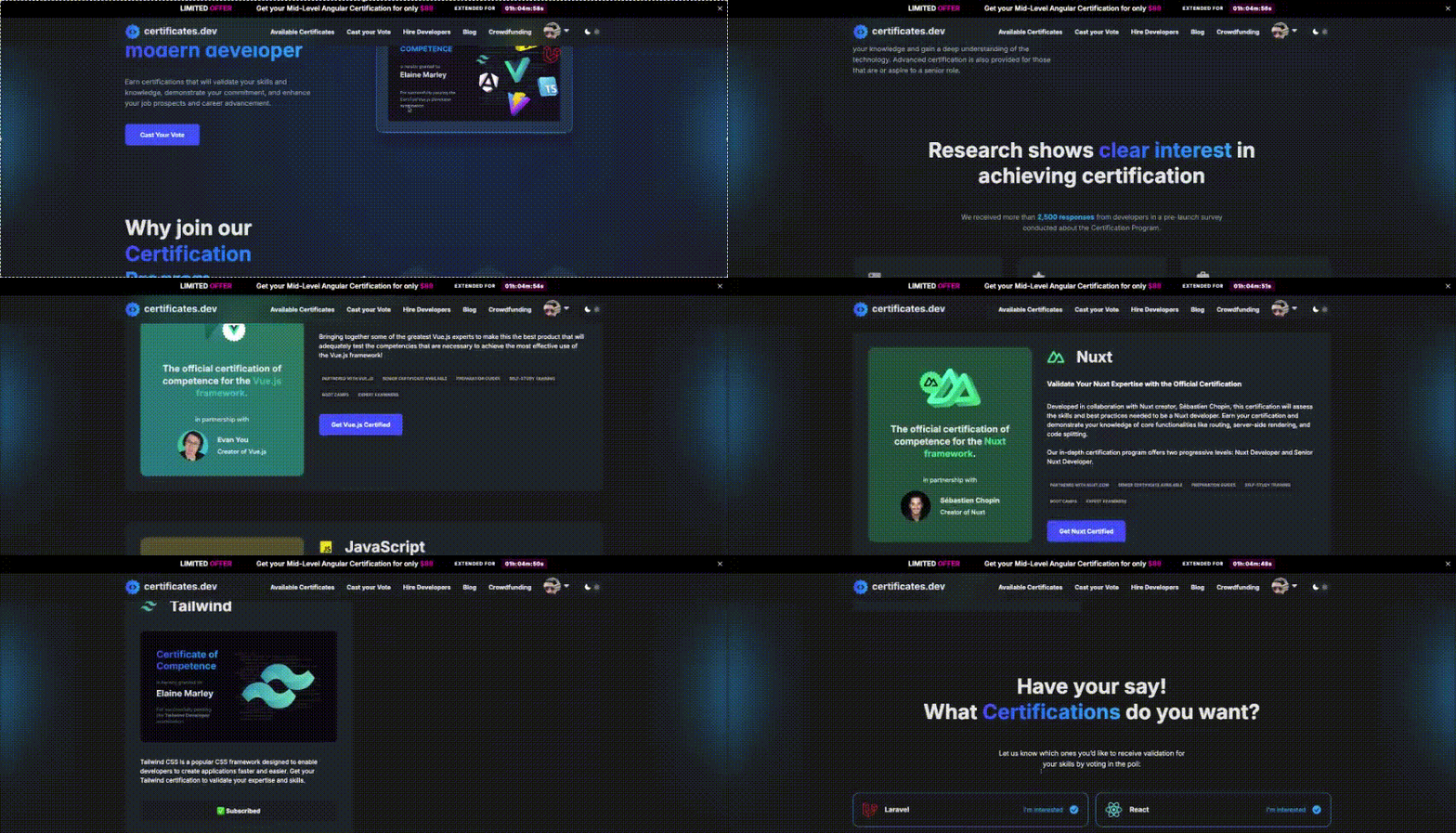
The platform's offerings extend beyond Angular as well, featuring certification paths for Vue.js, JavaScript, and Nuxt, with courses for React, TypeScript, and even Tailwind in development. Each certification is crafted in partnership with industry experts and platform founders, making the entire catalog a compelling proposition.
First Impressions: Exploring the Dashboard
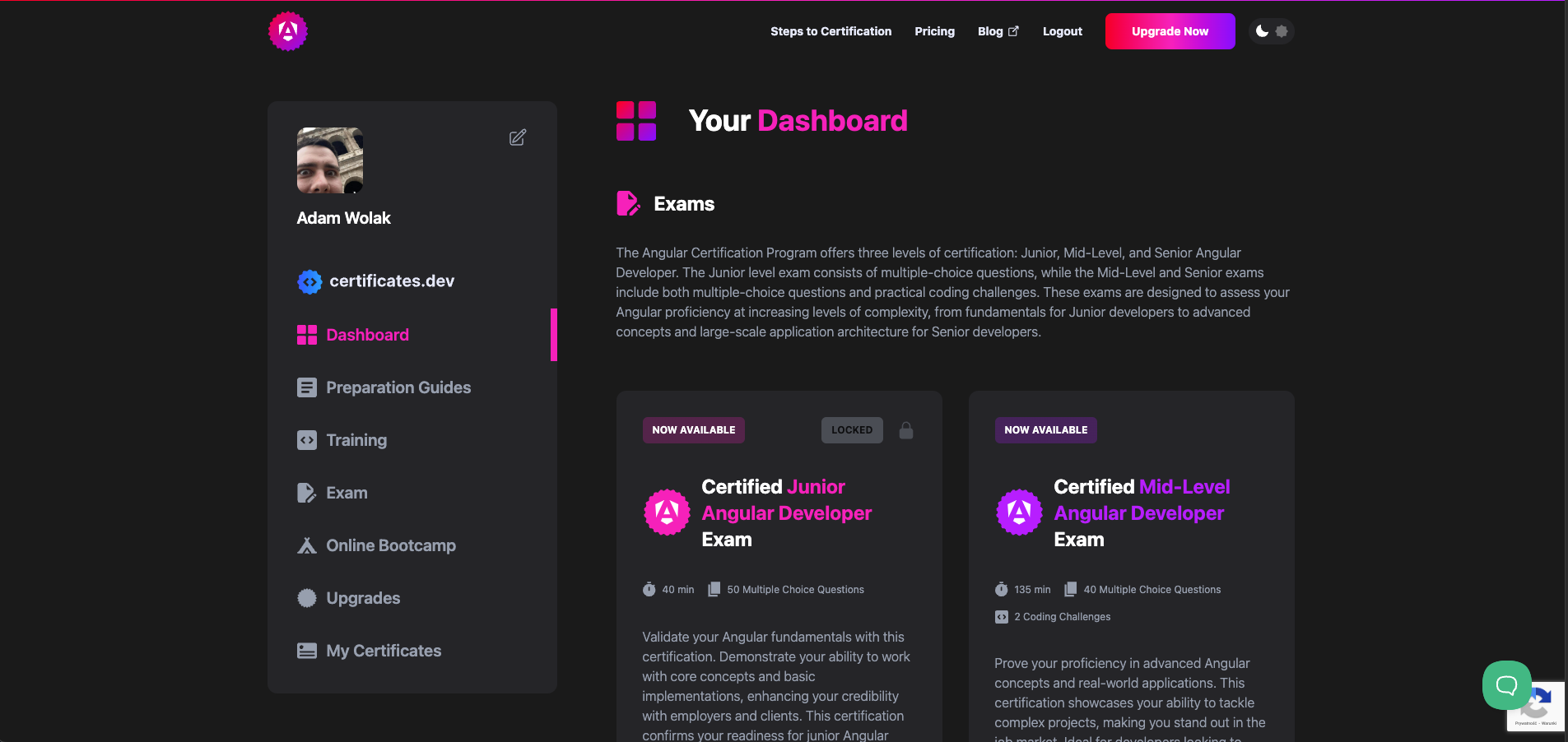
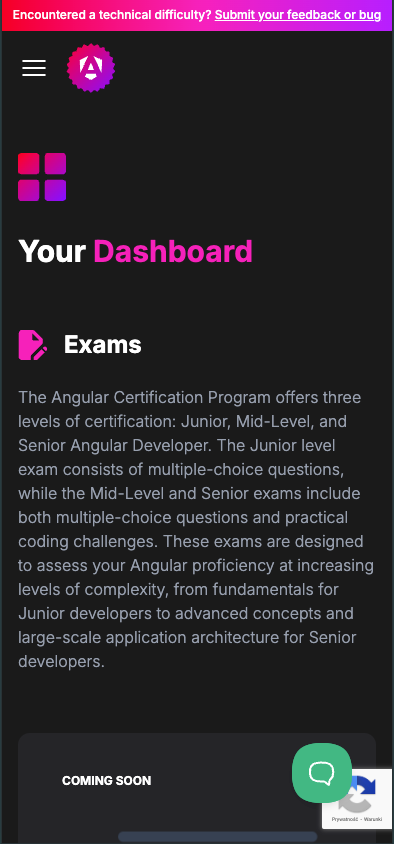
Logging in for the first time left me genuinely impressed. The dashboard’s visual design cleverly incorporates Angular’s updated branding colors. Navigating the interface is straightforward: a left-hand panel lists available features and profile details, while the right side displays descriptions of the actions you can take. My immediate reaction was, "It's entirely feasible to design a polished, Angular-themed interface without relying on Material Design, isn't it?"
Beyond the desktop experience, I found the mobile responsiveness to be a welcome surprise. Knowing a course's accessibility across devices is a key factor for me. During a work pause, I often prefer a larger screen, but other times I'm reviewing material while traveling (as a passenger, naturally!) or in the evening. The site's performance on smaller screens was remarkably smooth.
Working Through the Training Modules
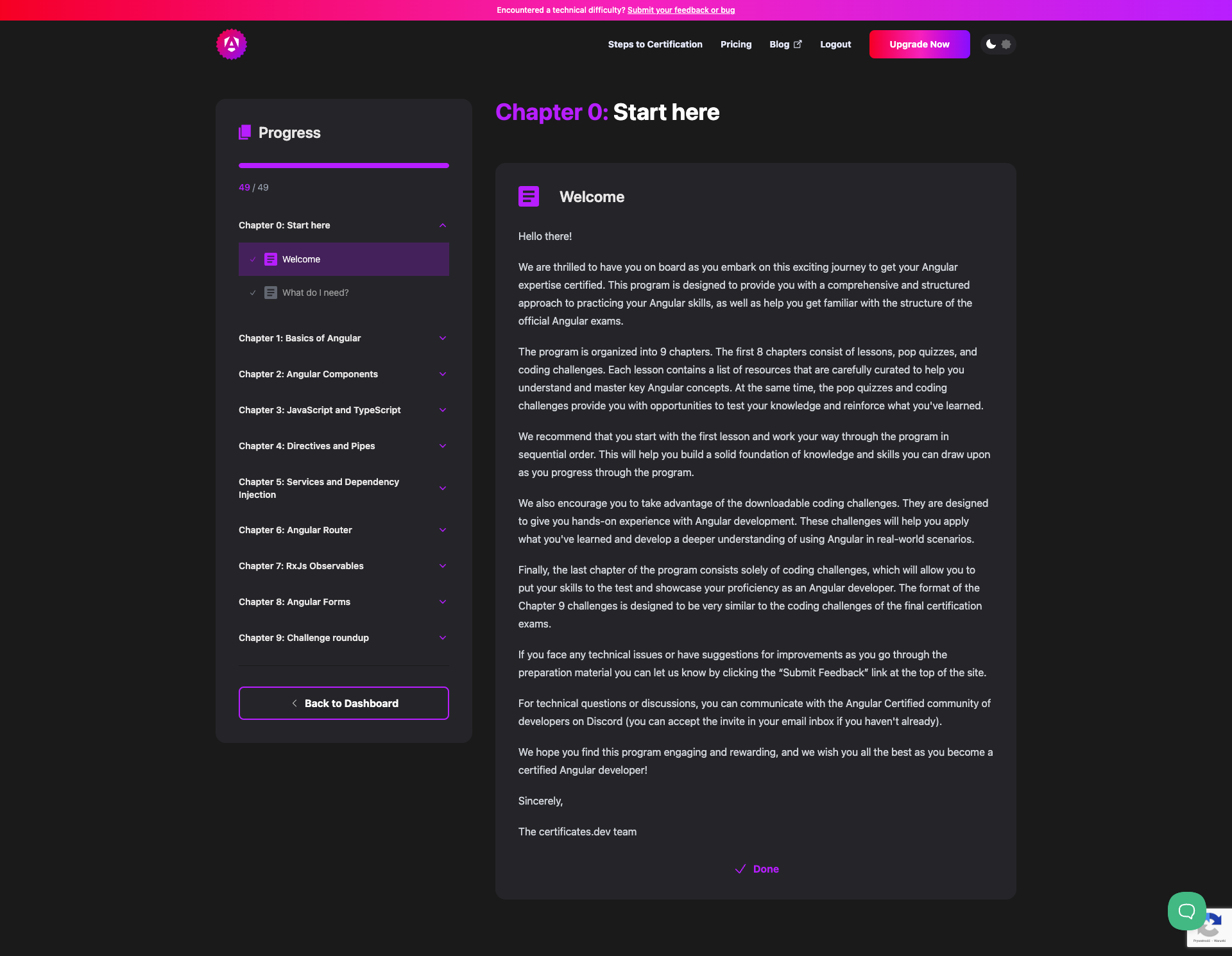
Given my initial hesitation about diving straight into the final assessment, I dedicated the following evening to exploring the training content. The learning environment mirrors the main dashboard's aesthetic, featuring a progress indicator on the left and the core material on the right—maintaining clarity and responsiveness throughout.
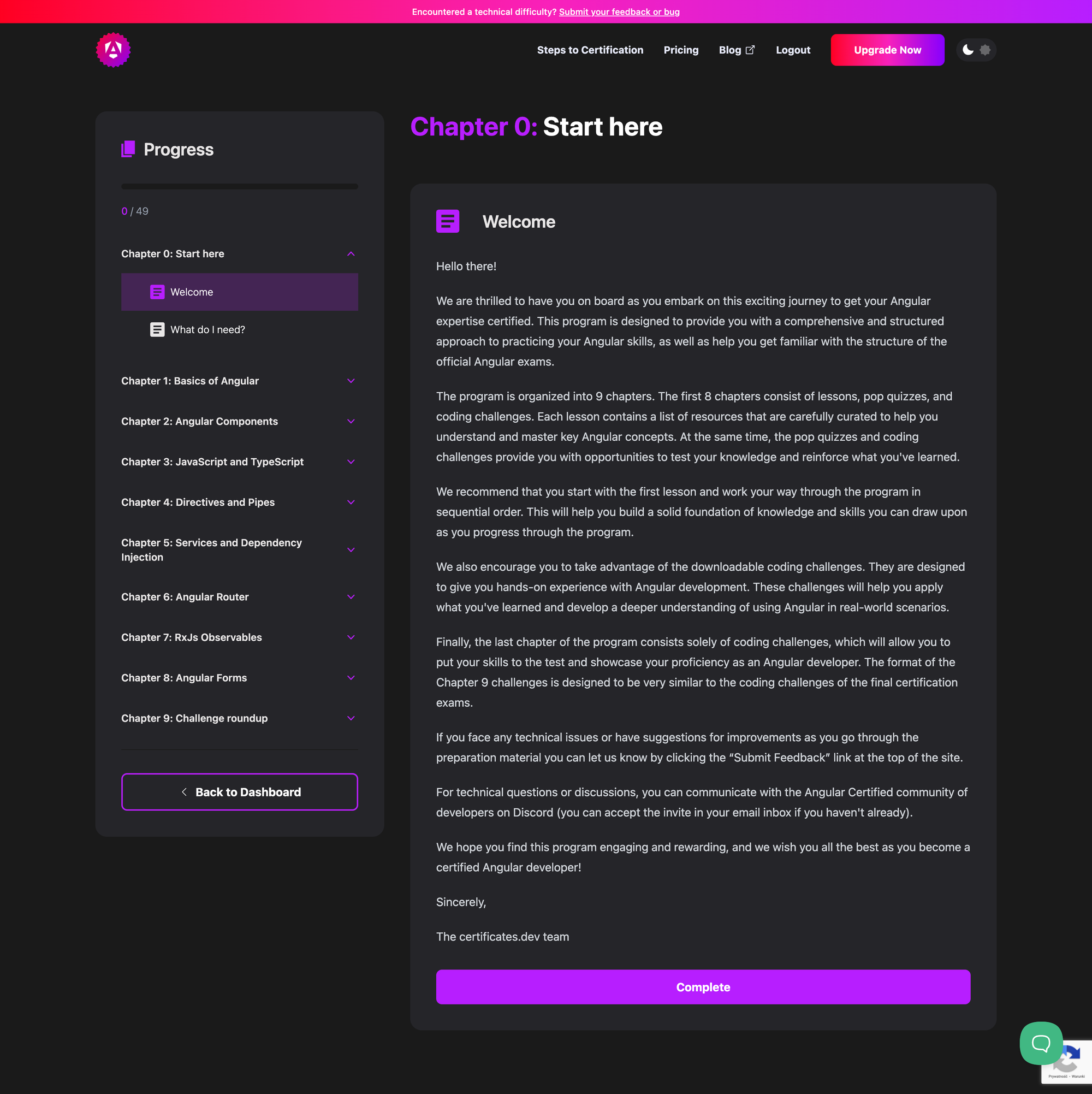
The course structure, however, took me by surprise.
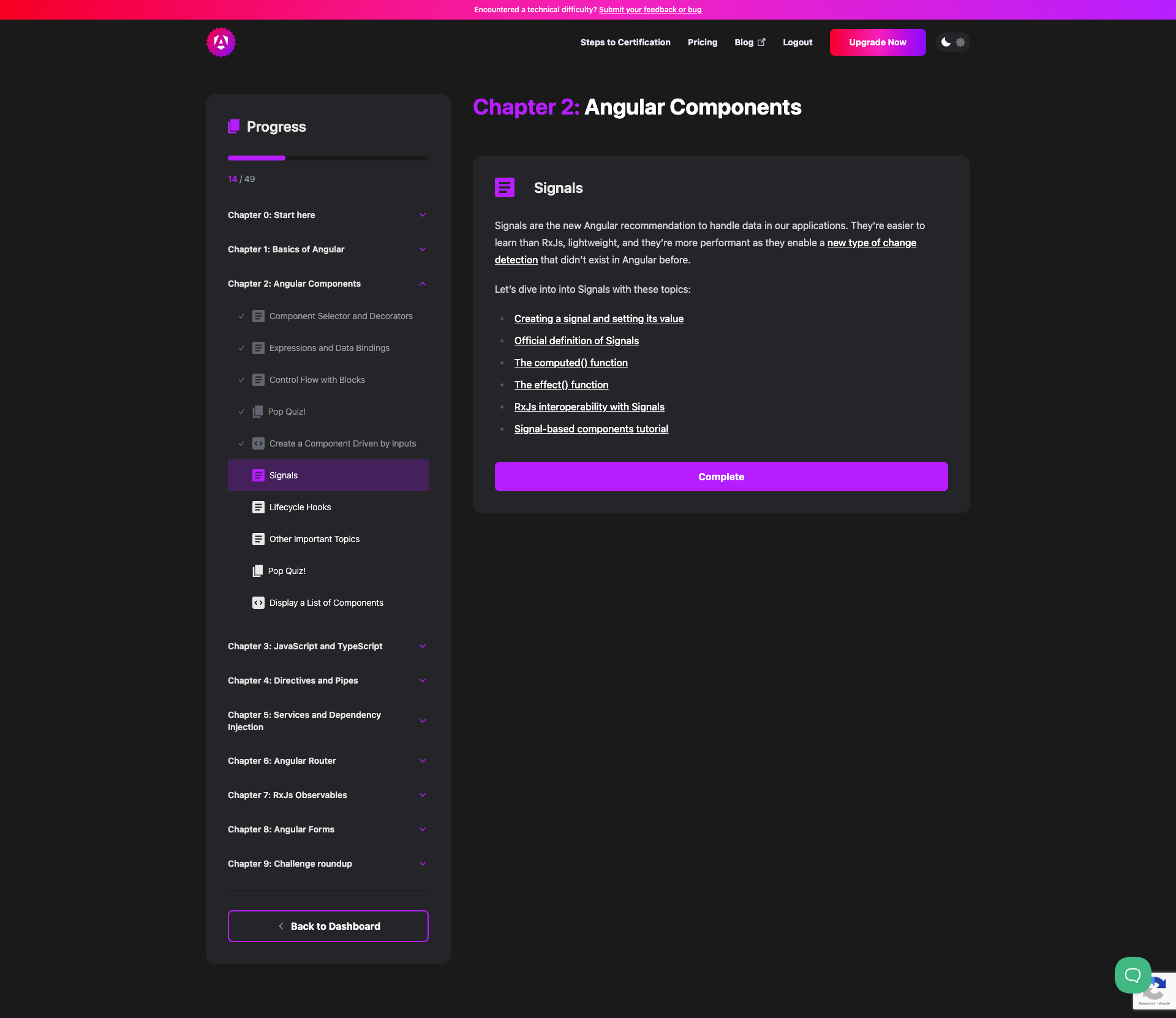
The sample chapter above focuses on Angular Signals. This instructional model stands in stark contrast to any other course I've come across previously.
My assumption was that the curriculum would consist of comprehensive written guides or video lectures. Instead, learners are presented with a concise overview of the chapter's subject matter followed by a curated collection of valuable links.
Initially, this methodology left me somewhat puzzled. Certain Angular features are so complex they warrant entire conference presentations, yet they are distilled here into a brief summary and a few resource links. Did this imply a superficial educational experience? Not at all.
Adapting to this style took a bit of time. The featured links direct learners predominantly to the official Angular documentation, Angular Training's blog, and articles by Alain Chautard under the Angular Training banner. This represents a distinctive pedagogical choice: rather than crafting lengthy lessons, the platform curates a focused knowledge repository—content that is both targeted and requires only a few minutes to digest.
Here’s an example of the article format, specifically regarding "Standalone Components":
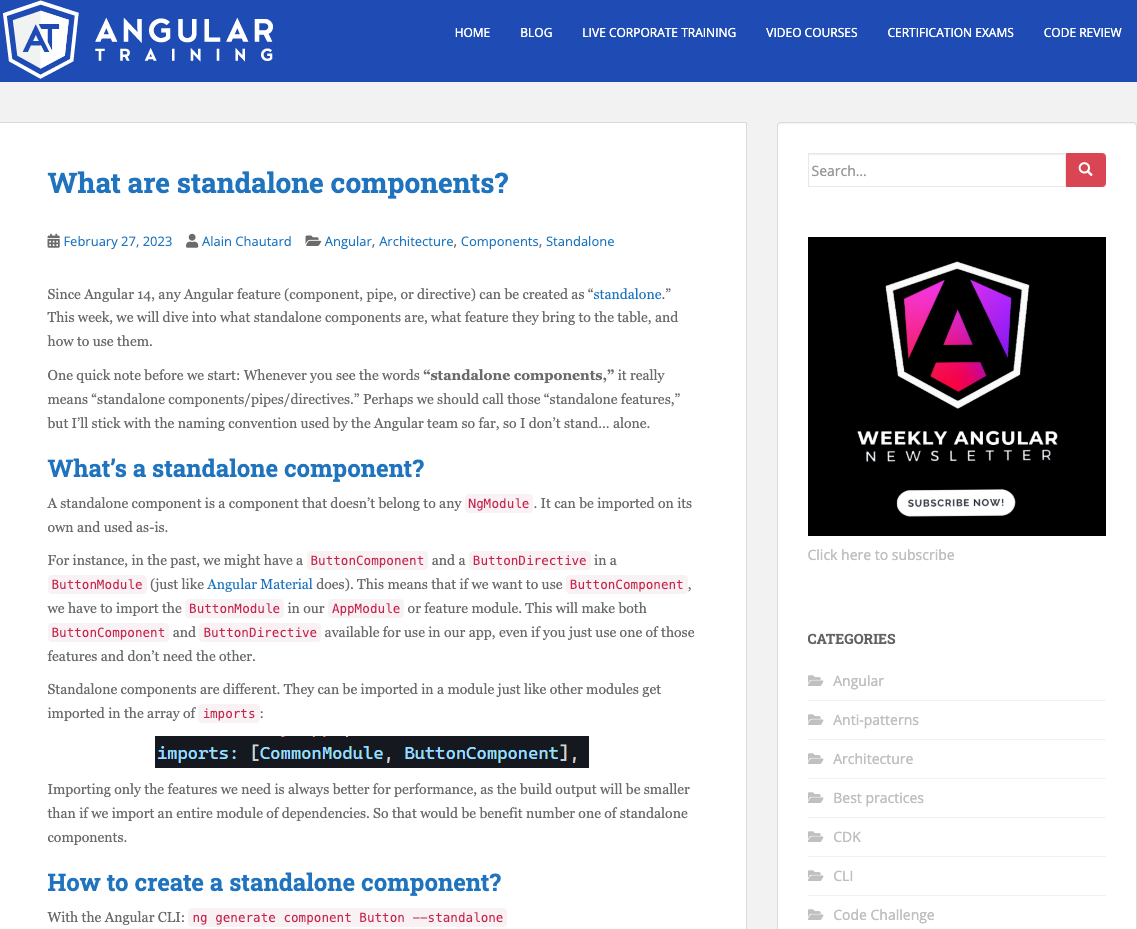
A logical question arises: if these resources are freely available online, why pay a subscription for someone to organize them? My response centers on efficiency. The internet is saturated with content of inconsistent quality. Many posts, in my experience, adopt a tutorial format that forces you to wade through Node.js installation steps, Angular CLI commands, and boilerplate project setup before reaching the substantive topic. The materials provided here are vetted by Google Developer Experts, eliminating extraneous detail to remain topic-focused. The expectation is that you possess foundational knowledge, but a concise article serves to sharpen your existing expertise.
Nevertheless, this approach presents a notable disadvantage: engaging with the course on a mobile device becomes cumbersome. My attempts to work through lessons during short breaks were hampered by the need to switch among multiple browser tabs constantly. I ultimately found it necessary to complete some modules on a desktop computer.
Regularly interspersed within the chapters are quizzes!
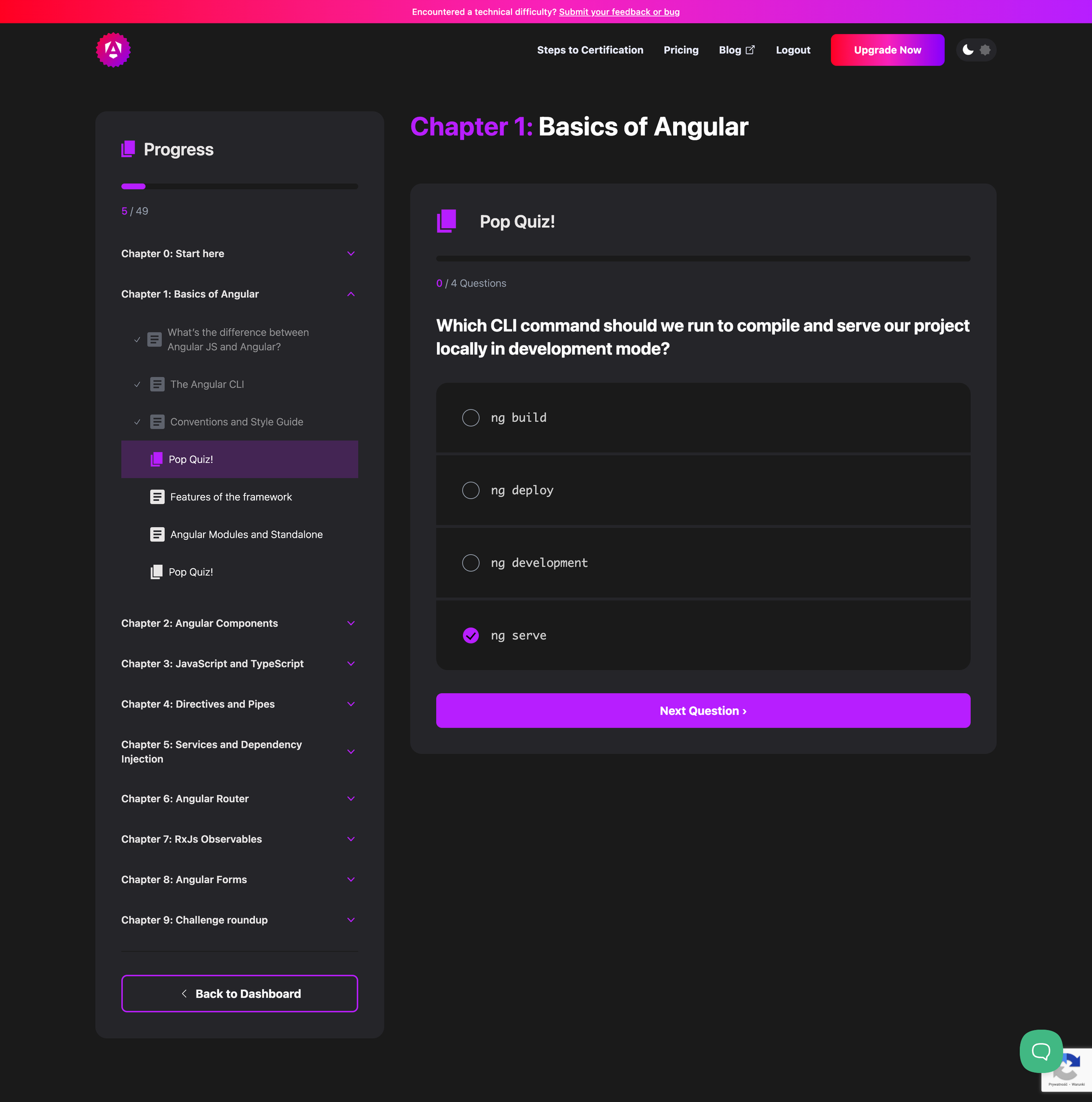
The quiz questions are thoughtfully crafted and align directly with the chapter's subject matter. I encountered no errors in them, and they proved to be an effective tool for consolidating knowledge.
Furthermore, the course incorporates practical challenges. These involve downloading a starter project and modifying it to meet specified criteria.
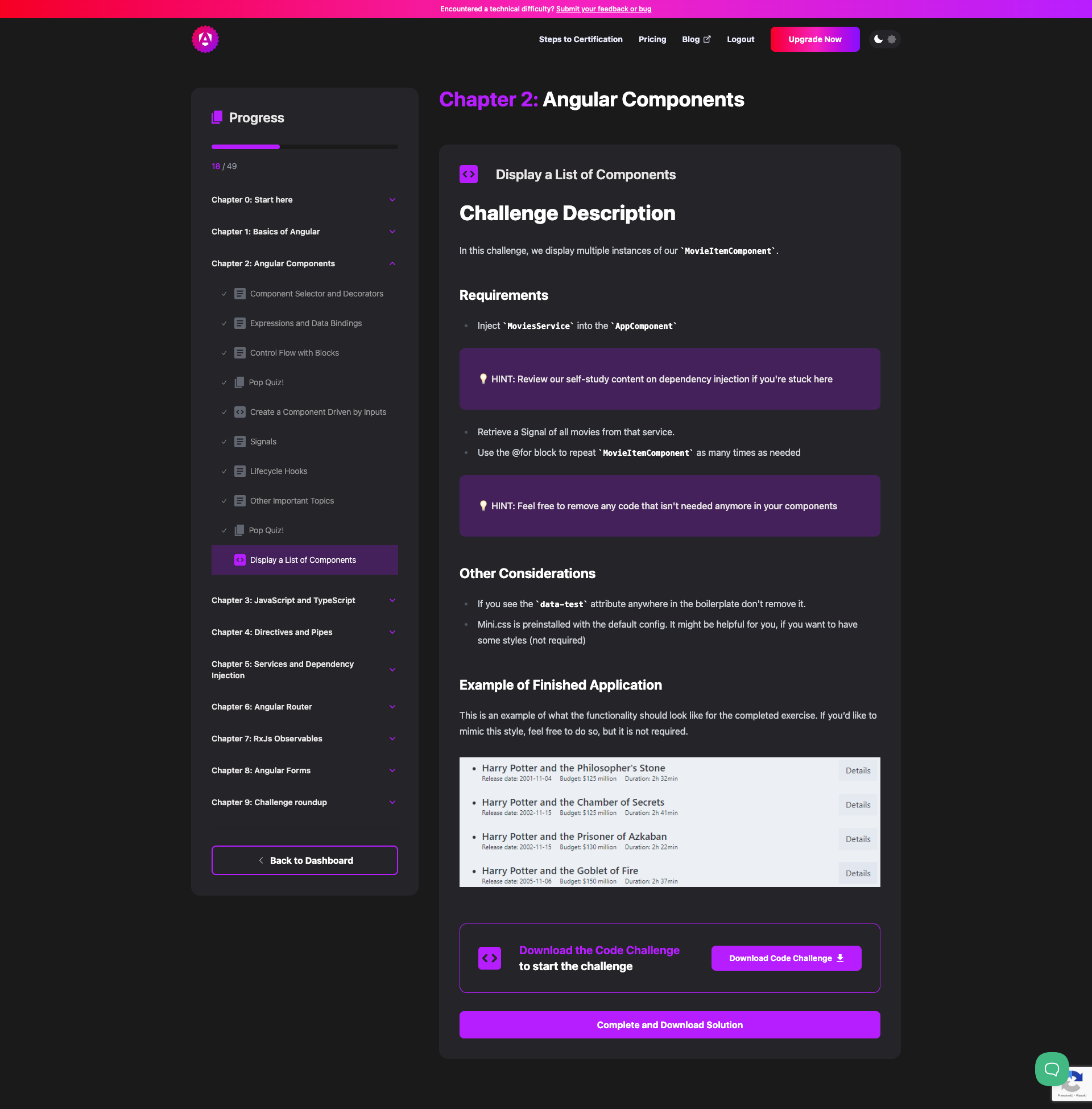
One essential element, however, was missing—a system to confirm whether my solutions were accurate. I realize that designing an automated grader is a substantial undertaking; implementing unit tests could offer a viable alternative. Rather than requiring external manual comparison, users could develop code, validate it in a browser, and execute unit tests to assess their work.
Spreading about an hour daily over a few days, I managed to finish the entire training, covering articles, quizzes, and assignments. For someone with intense focus, completing the whole training within a single day seems entirely feasible.
Looking for any gaps, I felt that a "Mid" level exam could reasonably assume a basic familiarity with @ngrx/store. A dedicated introduction to this topic, even as supplementary material excluded from the final exam, would have been appreciated. Additionally, expanding chapter five on Dependency Injection to mention InjectionToken or the usage of 'factory' within providers for components, modules, or the application root would be valuable. These might be classified as advanced topics, but having that knowledge is a significant asset.
The Exam Experience
Upon completion of the training, a "trial exam" becomes available. This rehearsal version contains fewer questions and simpler coding tasks, with a shorter time limit. Buoyed by my training, I opted to bypass the mock test and head directly for the official exam. As the exam commenced, however, my pulse quickened...
The exam's integrity measures are rigorous. Initial instructions outline the testing process and preparation requirements. Candidates are directed to activate their webcam and microphone, power down their phones, and disconnect any auxiliary monitors. An external service validates your identity, requests a view of your workspace to deter cheating, and monitors you continuously—recording your webcam feed, audio, and screen throughout. This surveillance is absent in the trial exam, so for first-timers, the reality of it can be quite stressful!
The examination is split into two distinct components. The first is a written portion featuring 40 multiple-choice questions. These cover the material presented during the training and are overwhelmingly Angular-focused, although I recall a few questions concerning JavaScript/TypeScript that demanded careful consideration. A 30-minute time limit applies, requiring a minimum of 29 correct answers for a pass.
The second component is a practical assessment consisting of two tasks. In the first, the challenge is to locate and remedy a bug within a pre-existing application. The recommended time is approximately 15 minutes, though it took me 25—a mark of shame! The second task requires implementing specific features based on provided requirements. To my relief, the starter app came with templates and mock data (simulating an API response), which meant I could concentrate purely on writing the TypeScript logic. I completed this second task with half an hour to spare, which felt like a small triumph!
A briefing video explaining the mechanics of the practical exam is available beforehand; for those interested, here’s a summary. Candidates receive a detailed statement of expectations. The coding environment is an editor provided via StackBlitz, pre-loaded with all required project scaffolding. This excludes the use of your chosen local IDE. Instead, a toolbar grants quick access to the assignment requirements, Angular's official docs, and MDN. These open within a "SideNav" panel—a well-executed design. This feature maintains code visibility, minimizes the possibility of external help, and importantly, eliminates the need to memorize documentation exhaustively. Recourse to official references is possible during the test as needed. For instance, I needed to apply a specific built-in Angular Pipe I had not used previously. A prompt documentation check clarified its arguments and allowed me to complete the implementation correctly!
Upon submission, all monitoring ceases. "Thank you for completing the exam," a message read, and I let out a sigh of relief. It also noted a grading window of roughly five business days. Yet, to my astonishment, by the next morning an email from Certificates.dev had arrived, informing me that...
I Achieved Mid-Level Angular Developer Certification!
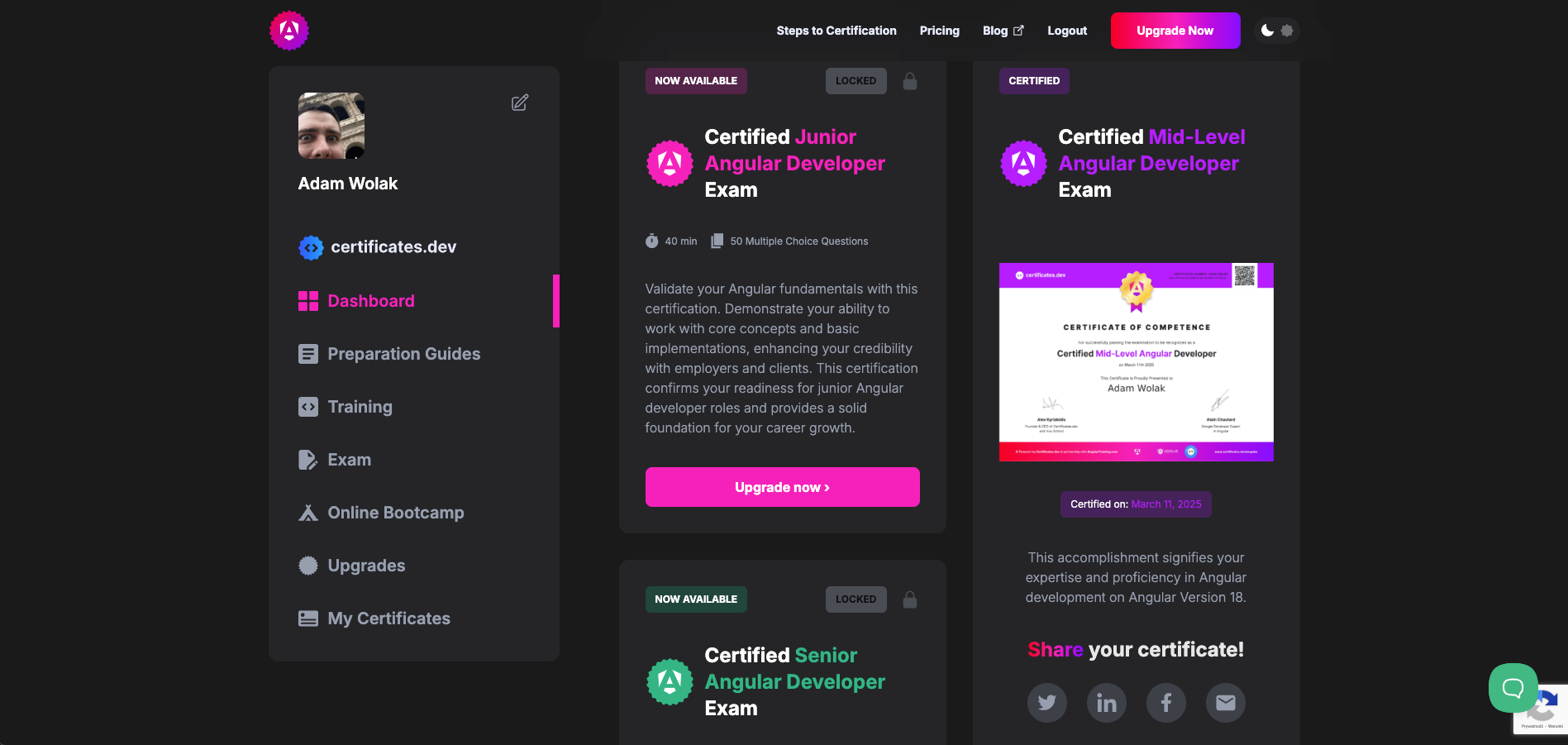
This certificate is downloadable, suitable for sharing on various social channels, and can be attached to the "Licenses & Certifications" portion of your LinkedIn page, likely inspiring a bit of envy among colleagues.
Final Thoughts and Recommendations
Would I recommend this platform to those aiming to learn or certify their Angular proficiency? Absolutely. The training imparts a substantial body of knowledge, underpinned by top-tier articles written by authentic subject matter experts. The Mid-Level certification itself is fairly calibrated; its scope aligns perfectly with the topics I would feel comfortable discussing in an interview with another "Mid-Level developer."
I am deeply appreciative of AngularSpace for offering me this testing opportunity, but my most significant praise is reserved for the founders of Certificates.dev. Their platform is a considerable achievement, adopting a novel yet effective strategy for both knowledge transfer and assessment. I anticipate this certification enhancing my confidence in future Angular dialogues.
It's safe to say I'll be monitoring this platform closely and engaging with its future content. I wish them the best in their continued growth and eagerly await new credential offerings. In fact, I've already enrolled in the React track, and the "Senior Angular Developer" path is likely next on my list—see you there!